
How Much Does HVAC Cost in Austin?
This price is for a standard AC Replacement in Austin. See other HVAC service prices ↓
That is the modeled cost to deliver plus a fair contractor margin, not a sales quote. Built from BLS metro wages, Craftsman labor hours, a real bill of materials, and hand-verified permit data. 2026-08-28
This is a central AC installation: a new condenser, coil, and lineset that reuse your existing furnace blower and ducts. It is cooling only, not a whole new system. Replacing the furnace and AC together as one gas system is the step up, a furnace-only swap the step down, and major duct rework is priced on its own.
Show the math
The margin is the gap between break even and a typical quote, not a markup we invent. Fair margin moves with trade and market. Most land at a 15 to 22 percent margin on the bid, roughly 18 to 28 percent over the cost to deliver, and free labor does not exist. Full methodology.
Is your HVAC bid fair?
Calculate your Austin true cost.
Show the math: how Austin Central Air Conditioning Installation numbers are derived Click to expand
What you pay for in Austin.
Every HVAC dollar in Austin, split into labor, materials, permit, overhead, and the contractor margin. The first four are the cost to deliver. On top of that sits the margin a fair job earns.
See cost by project size
What central air conditioning installation costs at your size.
Priced at the standard ton sizes. Pick the one that matches your system.
| Size | Typical | Range |
|---|---|---|
| 2 ton | $6,963 | $6,436 to $7,530 |
| 3 ton | $9,593 | $8,867 to $10,375 |
| 5 ton | $12,371 | $11,435 to $13,380 |
Scaled from TheFatBook's per-size cost model, the same one behind the calculator.
Heat pump, furnace, or mini-split?
The three system types most Austin homes weigh, with real local install cost. Pick by your climate and whether you already have gas and ductwork.
- Heats and cools in one system
- No gas, very efficient in mild winters
- Highest upfront cost
- Leans on backup heat in deep cold
- Strong, cheap heat in hard winters
- Lower upfront than a heat pump
- Heating only, you still need AC
- Burns gas and needs venting
- No ductwork required
- Zone each room on its own
- One indoor head per zone adds up
- Wall units are visible
Austin runs about four percent below the national average for central air conditioning installation. The city average sits at $9,593 while the lowest realistic price comes in at $8,867. I built the index that pulls these numbers straight from Craftsman hours, BLS wages, FRED material trends and verified permits so you can see exactly where bids get fat.
Numbers on this page come from Craftsman labor hours, BLS OES May 2025 wages for Austin, FRED material prices, and the verified local permit fee. Population, income, home values and housing age come from the U.S. Census Bureau (QuickFacts and the American Community Survey); unemployment from the BLS Local Area Unemployment Statistics; building permits from the Census Bureau via FRED. How we calculate
Local Market
Austin flipped from a mid tier Texas market to one of the pricier ones in under five years. Population growth of 4.6 percent through 2025 pushed labor demand hard. BLS shows base wages at $30.74 per hour here. Tech jobs keep pulling skilled tradesmen away. Yet the loaded rate lands at $42.37 after the 37.8 percent burden for taxes and insurance. Materials add $5,021 on a typical central air job. The cost to deliver comes to $7,663. That average of $9,593 therefore carries a 20.1 percent contractor margin. Building permits dropped from 4,000 a month in the boom years to about 1,800 in early 2026. The market corrected but contractor pricing hasn't. High median income of $93,658 with no state income tax gives them room to hold those margins. (TheFatBook cost index, 2026) (BLS OEWS wage input)
Twenty percent margin in a city growing this fast tells me the contractors hold the cards. Austin wages run higher than the rest of Texas but not by much. Still they charge like the coasts. I saw the same thing back home in Jefferson City when the lake houses started going up. Everybody raised prices and nobody lowered them when things cooled off. Sounds about right for a hot market.
Understanding Your Bid
A $10,375 bid on central air in Austin looks normal until you run the numbers. The cost to deliver sits at $7,663. That leaves a 20.1 percent spread to the $9,593 average. Not outrageous but not lean either. The lowest realistic price of $8,867 gives you $726 of potential savings if you shop carefully. Many bids I see come in closer to the high end of $10,375. Still, those carry extra margin that has nothing to do with the 27.5 craftsman hours or the $67 permit. Contractors in this market know homeowners with $555,300 median home values can absorb it. The data shows the leverage still sits with them. Compare any quote against the floor before you sign. (TheFatBook cost index, 2026)
Check your bid against these numbers →
Cost Breakdown
Break a central air installation down and the numbers get mechanical fast. Labor eats 27.5 craftsman hours at the loaded rate of $42.37 per hour. That produces $1,165 in burdened labor cost. Materials run $5,021 once FRED PPI adjustments are applied. The permit is a flat $67. Add the $1,410 overhead allocation from NAHB benchmarks and you reach the $7,663 cost to deliver. Everything above that's margin. The verified floor of $8,867 sits a step above delivery cost. That gap reflects the leanest sustainable margin in this market. Austin bids sometimes hide extra profit in the equipment markup or in upselling duct sealing that may not be needed. The $9,593 average is defensible. The $10,375 high end usually isn't. (Craftsman, 2026) (FRED PPI, 2026) (PermitCalculator, 2026)
The real money sits in that forty two dollar loaded rate and the materials. Almost five thousand in equipment leaves plenty of room to pad. I'd tell my own crew to sharpen the pencil on the labor hours and leave the markup honest. If this were my house I'd pay right at the floor and make sure the condensate line gets sloped right the first time. Take that price to the bank.
How to Negotiate
Shop your HVAC job in the shoulder months before the heat hits. Late July through early September slows exterior work in Austin even though emergency replacements still spike. Use that window to get multiple bids without the panic premium. It'll show you instantly whether the price sits near the $8,867 floor or closer to the padded average. Ask the contractor to break out the equipment cost separate from labor and markup. Then compare it against the $5,021 material number in our data. Push back on anything that exceeds the $7,663 cost to deliver by more than the 25.2 percent markup the average carries. Knowledge beats negotiation theater every time.
Ask the contractor what his price looks like if you schedule the job in September when the heat eases up. Honest ones will give you a straight number. The ones who hedge are working on margin not efficiency. Here's what fair looks like. about nine thousand and change for a clean central air changeout with proper brazing on the line set and a good vacuum on the compressor.
Price your own job in Austin →
What Makes This Market Different
What actually sets Austin HVAC costs apart is how fast the market changed. The city went from reasonable to expensive in a handful of years while the underlying BLS wages never reached coastal levels. Contractors learned they could charge near California prices in a no income tax state because median household income hit $93,658. Heritage tree rules and impervious cover limits in central Austin jack up site work on bigger jobs but even routine central air installs feel the ripple. Suburban crews avoid those fees entirely and still price as if they don't. The result is a weird spread where the $8,867 floor feels like a steal and the $10,375 high end feels like the new normal. Still. I didn't expect the pricing lag to last this long after permits dropped to 1,800 per month. Yet here we are. The index simply shows what the market actually bears.
Frequently Asked Questions
How much does central air conditioning installation cost in Austin?
What's the typical furnace replacement cost in Austin?
How much does HVAC repair cost in Austin?
Why are HVAC bids so different across Austin neighborhoods?
TheFatBook models HVAC from Craftsman labor hours, BLS regional wages, burden, PPI-adjusted materials, permit data where available, and contractor overhead benchmarks. Cost index version: 2026-08-28. Updated Aug 2026.
Sources & methodology for these numbers
- Independent FatBook v3 cost index for HVAC in Austin.
- BLS OEWS wage inputs (https://www.bls.gov/oes/) and FRED PPI material inflation (https://fred.stlouisfed.org/) references.
- Craftsman labor-hour references and contractor overhead benchmarks.
- Verified permit/source data from PermitCalculator.com and permits_compiled where available.
What the HVAC in austin benchmark includes.
- Central Air Conditioning Installation as the headline cost-index scope
- labor-hour assumptions, regional wage inputs, materials, overhead, and permit data where available
- low, average, high, lowest realistic price, margin, and savings benchmarks from the FatBook cost index
- hidden damage, change orders, emergency service premiums, or unusual site access conditions
- contractor financing approval, warranties, provider recommendations, or guaranteed final quotes
- permit rulings for a specific address unless the city permit panel lists verified local data
Embed this chart on your site (free, with attribution)
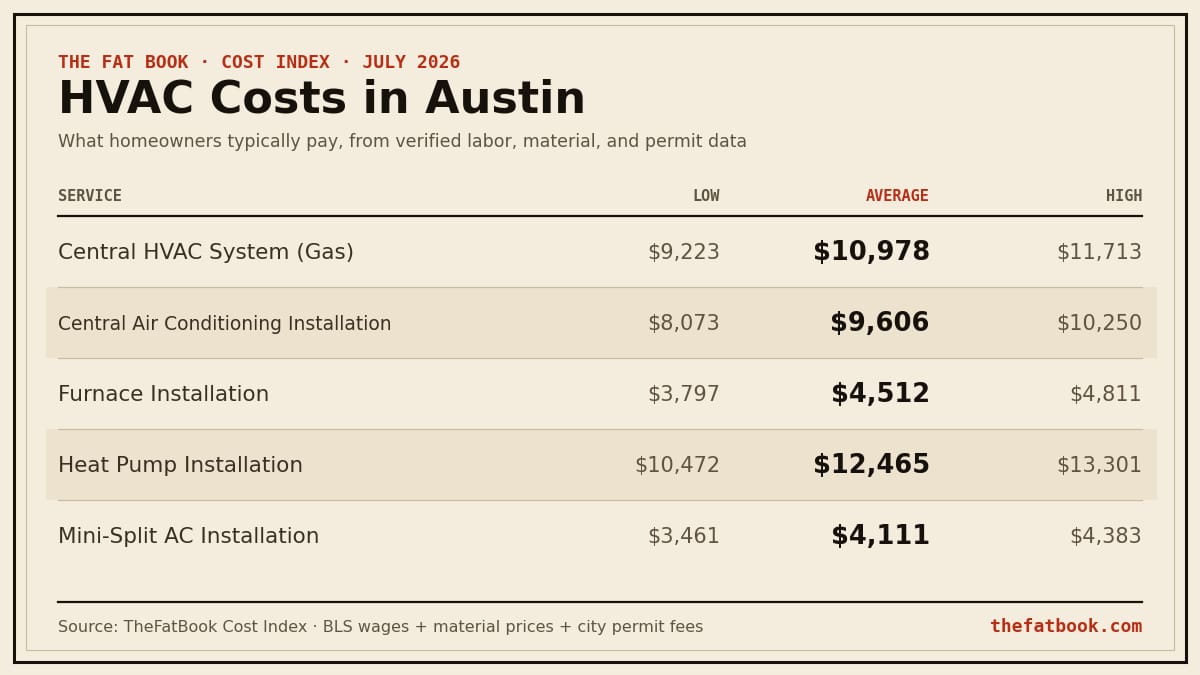
| Service | Low | Average | High |
|---|---|---|---|
| Central Air Conditioning Installation · 3 ton | $8,867 | $9,593 | $10,375 |
| Add AC to Existing Furnace | $7,967 | $8,608 | $9,298 |
| Furnace Installation | $3,302 | $3,509 | $3,878 |
| Mini-Split AC Installation · 1 ton | $3,798 | $4,065 | $4,417 |
| Heat Pump Installation · 3 ton | $10,103 | $10,940 | $11,840 |
| Central HVAC System (Gas) | $10,539 | $11,320 | $12,160 |
| Mini-Split Heat Pump Installation · 1 ton | $3,798 | $4,065 | $4,417 |
| Remove Heating System | $260 | $301 | $346 |
| Baseboard Heater Installation | $670 | $757 | $849 |
| Gas Wall Furnace Installation | $2,323 | $2,498 | $2,686 |
| Hydronic Heating Installation | $10,305 | $10,843 | $12,458 |
| Ductwork Installation | $9,283 | $10,741 | $12,310 |
| Attic Insulation Installation · 1,000 sqft | $2,541 | $2,886 | $3,258 |
| Fiberglass Batt Insulation · 1,000 sqft | $2,779 | $3,162 | $3,574 |
| Blown-In Insulation · 1,000 sqft | $2,236 | $2,533 | $2,852 |
| Rigid Foam Insulation · 200 sqft | $1,057 | $1,166 | $1,284 |
| Whole-House ERV/HRV Installation | $2,667 | $2,873 | $3,094 |
| AC Repair | $240 | $278 | $319 |
| Furnace Repair | $240 | $278 | $319 |
| Multi-Zone Mini-Split Installation | $5,476 | $5,817 | $6,483 |
| Spray Foam Insulation · 1,000 sqft | $3,034 | $3,458 | $3,913 |
| Boiler Installation | $4,322 | $4,643 | $5,030 |
| Whole-House Dehumidifier Installation | $2,308 | $2,437 | $2,674 |
| Wood Stove Installation | $3,511 | $3,731 | $4,128 |
| Pellet Stove Installation | $3,263 | $3,464 | $3,769 |
| Gas Fireplace Installation | $3,080 | $3,271 | $3,616 |
| Chimney Liner Installation | $2,801 | $2,991 | $3,196 |
Before you get bids in Austin.
Austin permits.
Plumbing base: $200
HVAC base: $116
Source-backed permit facts from PermitCalculator.com and the underlying permits_compiled dataset. Always confirm final requirements with the local building department before filing.
Got a bid? We'll check it.
Payment options.
Also in Austin: 6 other trades
Find a Contractor
Need a HVAC pro in Austin? Browse review-screened Austin contractors in the Better Builders Network. BBN Elite status comes from homeowner ratings and real customer reviews.