
How Much Does HVAC Cost in Chicago?
This price is for a standard AC Replacement in Chicago. See other HVAC service prices ↓
That is the modeled cost to deliver plus a fair contractor margin, not a sales quote. Built from BLS metro wages, Craftsman labor hours, a real bill of materials, and hand-verified permit data. 2026-08-28
This is a central AC installation: a new condenser, coil, and lineset that reuse your existing furnace blower and ducts. It is cooling only, not a whole new system. Replacing the furnace and AC together as one gas system is the step up, a furnace-only swap the step down, and major duct rework is priced on its own.
Show the math
The margin is the gap between break even and a typical quote, not a markup we invent. A fair margin floats by trade and market, most landing at a 15 to 22 percent margin on the bid, about 18 to 28 percent over the cost to deliver, and nobody works for free. Full methodology.
Is your HVAC bid fair?
Calculate your Chicago true cost.
Show the math: how Chicago Central Air Conditioning Installation numbers are derived Click to expand
What you pay for in Chicago.
Every HVAC dollar in Chicago, split into labor, materials, permit, overhead, and the contractor margin. The first four are the cost to deliver. Margin is the earned part on top.
See cost by project size
What central air conditioning installation costs at your size.
Priced at the standard ton sizes. Pick the one that matches your system.
| Size | Typical | Range |
|---|---|---|
| 2 ton | $7,889 | $7,394 to $12,331 |
| 3 ton | $10,777 | $10,101 to $16,846 |
| 5 ton | $13,825 | $12,957 to $21,609 |
Scaled from TheFatBook's per-size cost model, the same one behind the calculator.
Heat pump, furnace, or mini-split?
The three system types most Chicago homes weigh, with real local install cost. Pick by your climate and whether you already have gas and ductwork.
- Heats and cools in one system
- No gas, very efficient in mild winters
- Highest upfront cost
- Leans on backup heat in deep cold
- Strong, cheap heat in hard winters
- Lower upfront than a heat pump
- Heating only, you still need AC
- Burns gas and needs venting
- No ductwork required
- Zone each room on its own
- One indoor head per zone adds up
- Wall units are visible
Chicago comes in at $7,889 for central air conditioning installation. That sits 21 percent below the national average of $9,987. The verified floor lands at $7,394. I built the index that pulls these numbers straight from Craftsman hours, BLS wages, FRED material trends, verified permit fees and NAHB overhead. This page shows you exactly where bids sit in a union heavy market and what the spread really means for your wallet.
Numbers on this page come from Craftsman labor hours, BLS OES May 2025 wages for Chicago, FRED material prices, and the verified local permit fee. Population, income, home values and housing age come from the U.S. Census Bureau (QuickFacts and the American Community Survey); unemployment from the BLS Local Area Unemployment Statistics; building permits from the Census Bureau via FRED. How we calculate
Local Market
Chicago is a union town. Prevailing wage rules on public projects set a floor that bleeds into residential pricing (TheFatBook cost index, 2026). BLS wages here run 44.5 percent above national averages and that's structural. TheFatBook Cost Index puts the city average central air job at $7,889. That includes 16 craftsman hours at a loaded wage of $63.70 per hour. Materials sit at $4,178 after FRED PPI adjustments. Add the $0 permit and $1,279 overhead allocation and you land within a dollar of the $6,476 cost to deliver. The 17.9 percent contractor margin on top of that feels lean for this market. A 5.4 percent metro unemployment rate still hides real tightness in licensed trades where licensed plumbers and electricians command premium base wages. Median home value is $334,100 yet the project to income ratio lands among the toughest in our index. Old housing stock from 1953 on average piles on retrofit pressure most newer cities never see. And the winter slowdown from November through March is when crews get hungry for interior work like this.
Chicago homes average 1953 construction. That means a crew often hits full dimension lumber and plaster walls the minute they open things up. The union wage floor pushes every bid higher than what I saw in Missouri. Those labor rates are structural. Sounds about right for that market.
Understanding Your Bid
Not every bid adds up here. The city average of $7,889 sits $495 above the lowest realistic price of $7,394. That gap is your negotiation room. The cost to deliver comes in at $6,476 before any margin. I calculate contractor margin as 17.9 percent by taking the spread between average and that delivery number divided by the average. Some bids climb all the way to $12,331. Those usually hide extra markup that has nothing to do with labor or materials. The floor is modeled as cost to deliver plus the leanest sustainable margin for HVAC in Chicago. It is not a bid we watched come in and it is not bare cost. Anything under $7,394 starts to look like someone is skipping overhead or cutting corners on insurance. But a quote near $7,889 with clean line items can be solid. The spread between average and floor tells you how much room exists before the number stops being defensible.
Check your bid against these numbers →
Cost Breakdown
Sixteen craftsman hours at the loaded rate of $63.70 per hour produces $1,019 in labor (Craftsman, 2026). That loaded wage starts from a $45.01 base BLS figure plus 41.5 percent burden for taxes, insurance and benefits. Materials land at $4,178 after FRED PPI tracking. The permit is a flat $0 in Chicago for this scope. Overhead allocation adds $1,279 using NAHB benchmarks. Those pieces combine into a cost to deliver of $6,476. The city average of $7,889 leaves $1,413 for margin and contingencies. Union labor costs drive much of the difference versus national numbers. 38.8 percent of Chicago homes were built in 1939 or earlier so crews often hit plaster and lath walls, old knob and tube wiring or undersized returns once they open things up. That hidden work can push a clean quote higher fast. The 17.9 percent margin looks reasonable against other markets. But watch materials. A contractor who marks up line sets or refrigerant beyond the tracked $4,178 number is padding where he shouldn't.
about four thousand in materials tracks with what a proper central air setup takes these days. But some guys will still mark up the copper and refrigerant another grand. That's where the fat hides. What's your supplier cost on that line set?
How to Negotiate
Shop in the December through February window. Crews shift indoors during the freeze and they negotiate harder then. Get bids on central air installation before your system fails completely. Know the $7,394 floor and the $7,889 average before you sit down with any contractor. That shows you the loaded labor, materials and overhead in plain numbers. Ask the contractor to break out his labor hours and material suppliers instead of quoting the floor price at him. Tell him you want to understand how he lands near the lowest realistic number without cutting safety. Mention the $0 permit so you confirm he included it. If he pushes back on winter scheduling push for a firm start date. The $495 spread between average and floor gives you real leverage if you stay calm and compare three solid bids. Do that and you keep the savings instead of handing it over.
Use that about seven thousand floor as your yardstick but never lead with it on the phone. Ask instead how he hits the average without padding overhead. Winter work in Chicago gives you leverage because crews want the indoor jobs. In Missouri we had more flexibility on timing and the bids showed it.
Price your own job in Chicago →
What Makes This Market Different
Chicago surprised me more than most cities. The union floor on wages is baked in so deep that even a simple central air swap carries index wages 44.5 percent above national. Median housing age of 1953 means crews routinely cut into 1930s plaster and lath or discover galvanized returns that need full replacement. That retrofit reality adds real cost no spreadsheet can fully capture yet our index still shows this city 21 percent below national average. That adds up. I expected higher. Still, the $0 permit feels almost too low for a town that loves paperwork but it matches the verified data. Old masonry homes suffer constant freeze thaw damage so duct runs often need extra sealing or rerouting. The 5.4 percent unemployment rate masks a chronic shortage of licensed HVAC techs who can braze copper line sets or pull a proper vacuum on a hot July day. That holds across the board. And honestly, most other big cities let you chase price harder. Here the union climate and ancient housing stock compress the spread. The $7,394 floor isn't charity. It's what an efficient crew can defend while still covering their burdens in a market where every job risks unexpected structural surprises.
Frequently Asked Questions
How much does central air conditioning installation cost in Chicago?
How much does furnace replacement cost in Chicago?
What's the average cost for HVAC repair in Chicago?
Why is HVAC labor more expensive in Chicago than other cities?
TheFatBook models HVAC from Craftsman labor hours, BLS regional wages, burden, PPI-adjusted materials, permit data where available, and contractor overhead benchmarks. Cost index version: 2026-08-28. Updated Aug 2026.
Sources & methodology for these numbers
- Independent FatBook v3 cost index for HVAC in Chicago.
- BLS OEWS wage inputs (https://www.bls.gov/oes/) and FRED PPI material inflation (https://fred.stlouisfed.org/) references.
- Craftsman labor-hour references and contractor overhead benchmarks.
- Verified permit/source data from PermitCalculator.com and permits_compiled where available.
What the HVAC in chicago benchmark includes.
- Central Air Conditioning Installation as the headline cost-index scope
- labor-hour assumptions, regional wage inputs, materials, overhead, and permit data where available
- low, average, high, lowest realistic price, margin, and savings benchmarks from the FatBook cost index
- hidden damage, change orders, emergency service premiums, or unusual site access conditions
- contractor financing approval, warranties, provider recommendations, or guaranteed final quotes
- permit rulings for a specific address unless the city permit panel lists verified local data
Embed this chart on your site (free, with attribution)
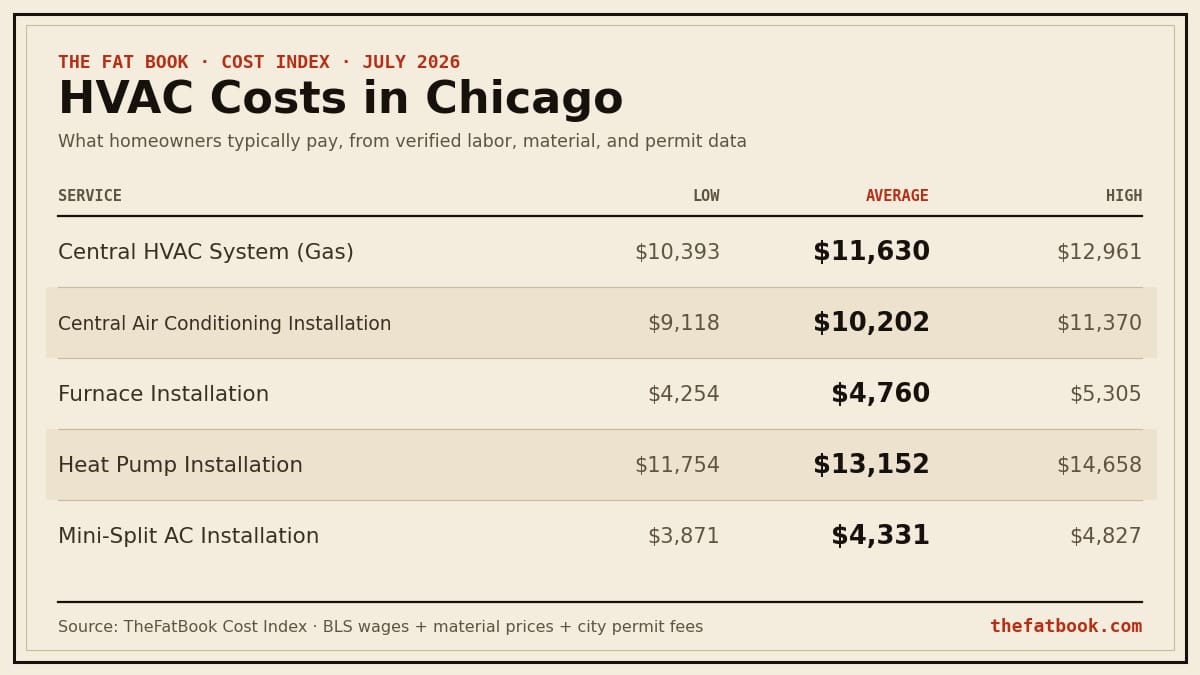
| Service | Low | Average | High |
|---|---|---|---|
| Central Air Conditioning Installation · 2 ton | $7,394 | $7,889 | $12,331 |
| Add AC to Existing Furnace | $8,988 | $9,633 | $10,328 |
| Furnace Installation | $3,660 | $3,875 | $4,542 |
| Mini-Split AC Installation · 1 ton | $4,334 | $4,610 | $5,297 |
| Heat Pump Installation · 2 ton | $8,427 | $9,058 | $14,056 |
| Central HVAC System (Gas) | $12,152 | $12,943 | $13,794 |
| Mini-Split Heat Pump Installation · 1 ton | $4,334 | $4,610 | $5,297 |
| Remove Heating System | $344 | $388 | $442 |
| Baseboard Heater Installation | $916 | $1,016 | $1,124 |
| Gas Wall Furnace Installation | $2,658 | $2,847 | $3,051 |
| Hydronic Heating Installation | $12,427 | $13,083 | $15,702 |
| Ductwork Installation | $11,573 | $13,015 | $14,568 |
| Attic Insulation Installation · 1,000 sqft | $2,531 | $2,855 | $3,204 |
| Fiberglass Batt Insulation · 1,000 sqft | $2,902 | $3,274 | $3,673 |
| Blown-In Insulation · 1,000 sqft | $2,211 | $2,494 | $2,799 |
| Rigid Foam Insulation · 200 sqft | $869 | $980 | $1,100 |
| Whole-House ERV/HRV Installation | $3,132 | $3,353 | $3,746 |
| AC Repair | $312 | $352 | $400 |
| Furnace Repair | $312 | $352 | $400 |
| Multi-Zone Mini-Split Installation | $6,237 | $6,599 | $7,784 |
| Spray Foam Insulation · 1,000 sqft | $3,141 | $3,543 | $3,976 |
| Boiler Installation | $5,032 | $5,375 | $6,135 |
| Whole-House Dehumidifier Installation | $2,617 | $2,756 | $3,185 |
| Wood Stove Installation | $3,953 | $4,181 | $4,906 |
| Pellet Stove Installation | $3,703 | $3,915 | $4,493 |
| Gas Fireplace Installation | $3,494 | $3,695 | $4,320 |
| Chimney Liner Installation | $3,178 | $3,375 | $3,751 |
Before you get bids in Chicago.
Chicago permits.
$12k building fee: $602
$25k building fee: $602
Electrical base: $75
Plumbing base: $75
HVAC base: $75
Source-backed permit facts from PermitCalculator.com and the underlying permits_compiled dataset. Always confirm final requirements with the local building department before filing.
Got a bid? We'll check it.
Payment options.
Also in Chicago: 6 other trades
Find a Contractor
Need a HVAC pro in Chicago? Browse review-screened Chicago contractors in the Better Builders Network. BBN Elite status comes from homeowner ratings and real customer reviews.