How Much Does HVAC Cost in Salt Lake City?
This price is for a standard AC Replacement in Salt Lake City. See other HVAC service prices ↓
That is the modeled cost to deliver plus a fair contractor margin, not a sales quote. Built from BLS metro wages, Craftsman labor hours, a real bill of materials, and hand-verified permit data. 2026-08-28
This is a central AC installation: a new condenser, coil, and lineset that reuse your existing furnace blower and ducts. It is cooling only, not a whole new system. Replacing the furnace and AC together as one gas system is the step up, a furnace-only swap the step down, and major duct rework is priced on its own.
Show the math
The margin is the gap between break even and a typical quote, not a markup we invent. Margins float by trade and city, with most fair jobs at a 15 to 22 percent margin on the bid, about 18 to 28 percent over the cost to deliver. Nobody works for free. Full methodology.
Is your HVAC bid fair?
Calculate your Salt Lake City true cost.
Show the math: how Salt Lake City Central Air Conditioning Installation numbers are derived Click to expand
What you pay for in Salt Lake City.
Every HVAC dollar in Salt Lake City, split into labor, materials, permit, overhead, and the contractor margin. The first four are the cost to deliver. The margin is what a fair job earns on top.
See cost by project size
What central air conditioning installation costs at your size.
Priced at the standard ton sizes. Pick the one that matches your system.
| Size | Typical | Range |
|---|---|---|
| 2 ton | $7,356 | $6,856 to $8,212 |
| 3 ton | $10,129 | $9,441 to $11,307 |
| 5 ton | $13,058 | $12,171 to $14,577 |
Scaled from TheFatBook's per-size cost model, the same one behind the calculator.
Heat pump, furnace, or mini-split?
The three system types most Salt Lake City homes weigh, with real local install cost. Pick by your climate and whether you already have gas and ductwork.
- Heats and cools in one system
- No gas, very efficient in mild winters
- Highest upfront cost
- Leans on backup heat in deep cold
- Strong, cheap heat in hard winters
- Lower upfront than a heat pump
- Heating only, you still need AC
- Burns gas and needs venting
- No ductwork required
- Zone each room on its own
- One indoor head per zone adds up
- Wall units are visible
Salt Lake City sits 1.4 percent above the national average for central HVAC. Yet that average of $10,129 hides real differences between what crews actually spend and what they charge. I built the index from Craftsman hours, BLS wages, FRED material inputs and verified permit fees so you can see the spread before you sign anything.
Numbers on this page come from Craftsman labor hours, BLS OES May 2025 wages for Salt Lake City, FRED material prices, and the verified local permit fee. Population, income, home values and housing age come from the U.S. Census Bureau (QuickFacts and the American Community Survey); unemployment from the BLS Local Area Unemployment Statistics; building permits from the Census Bureau via FRED. How we calculate
Local Market
Salt Lake City's HVAC market tells two stories at once. The city average sits at $10,129 while the verified floor reaches $9,441 (TheFatBook cost index, 2026). That $688 gap is where the real dynamics hide. Silicon Slopes added roughly 67,500 tech workers in recent years. That demand squeezes the pool of qualified crews and lifts contractor margins to 18.7 percent on a typical central air conditioning system. Utah adds a mandatory 1 percent state surcharge on every permit fee under code 15A-1-209. Our data carries that 1 percent on the cost side so the $113 permit line is fully loaded. BLS wage input shows local base pay at $30.13 an hour. Add the 40 percent burden for taxes and insurance and you get a loaded rate of $42.18. Craftsman counts 27.5 hours for a full central HVAC swap. Materials from the FRED PPI track at $5,261. Overhead lands at $1,702 using NAHB benchmarks. Put it together and the cost to deliver comes to $8,236. Winter inversions here trap bad air so many buyers push for better filtration. That demand keeps bids firm even when material prices flatten.
Silicon Slopes is flooding the valley with tech cash. That pushes wages near forty two an hour loaded and crews stay booked months out. The 1 percent permit surcharge is just part of doing business here. Call it a steady honest market with a boom premium on top.
Understanding Your Bid
Not every bid at $11,307 is padded (TheFatBook cost index, 2026). But many sit well above the $8,236 cost to deliver (TheFatBook cost index, 2026). That 18.7 percent contractor margin looks lean compared to some cities. Yet the verified floor of $9,441 still leaves $688 of potential savings on the table. I ran the numbers for a standard central air conditioning system. The spread feels honest on paper. But bids that ignore the Utah permit surcharge or lowball the 27.5 hours of labor usually come back with change orders later. TheFatBook Cost Index flags when a quote drifts too far from reality. It compares your number against the true cost to deliver and shows exactly where the fat hides. Most homeowners see only the final price. They miss that materials eat $5,261 before anyone turns a wrench. What matters is whether your contractor priced the job to stay in business or just to win the bid.
Check your bid against these numbers →
Cost Breakdown
Labor eats the first big chunk. The index uses 27.5 Craftsman hours at the loaded BLS rate of $42.18 per hour (Craftsman, 2026). That produces $1,160 in burdened labor. Materials adjusted through FRED PPI total $5,261 for a central air conditioning installation. The verified $113 permit already includes Utah's 1 percent surcharge. Overhead allocation adds $1,702 using NAHB benchmarks for insurance, trucks and office costs. Add those pieces and the fully loaded cost to deliver reaches $8,236. Everything above that line is margin. The city average of $10,129 therefore carries about 16.8 percent contractor margin. The verified floor of $9,441 sits $1,205 above the raw delivery number. That gap reflects the leanest sustainable margin in this market. Good crews can't stay in business at true cost to deliver. They need that buffer for warranty work and slow months. The math should still land near these totals.
About fifty three hundred in materials looks about right for a full AC system. But watch the markup on the condensing unit and that line set. Some guys double the supply house price and call it normal. Brazing the copper and pulling a proper vacuum should be in the labor not hidden in materials.
How to Negotiate
Shop in the shoulder months here. Avoid the peak summer rush when inversions ease and AC failures spike. Bids soften in April or October because crews need steady work. Get three quotes but compare them against the $8,236 cost to deliver before you negotiate. Don't open with the $9,441 floor price. Contractors hear that as a race to the bottom. Instead ask what filtration package or duct sealing they included for those winter inversion days. Then run your number through the checker on this page. It flags whether your bid sits near the average or closer to the realistic low end. Utah crews book fast because of tech money pouring into the valley. A solid contractor who explains his overhead and permit line is worth more than the cheapest paper. Use the savings gap of $688 as your walk away point only if the scope matches exactly. Otherwise pay a fair margin for someone who will show up when the furnace dies at 10 below.
Look for the guy who lists the permit fee separate with that Utah surcharge. Honest crews put it right on the bid. If he talks about charging refrigerant on a hot day or sealing ducts against inversions he probably knows the local drill. Take that quote to the bank before he books another tech job.
Price your own job in Salt Lake City →
What Makes This Market Different
The 1 percent state surcharge on every permit annoyed me when I first saw it in the data. Most cities roll permit costs into one line. Utah writes it out under code 15A-1-209 and sends 85 percent to the state for inspector training. The index puts that extra dollar on the expense side so the $113 fee is real. Then there's the air. Salt Lake's valley traps PM2.5 like few places in America. Families buy HVAC upgrades for MERV-13 filters and tight ductwork more than for raw BTUs. And the $10,129 average therefore buys cleaner air on inversion days not just temperature control. Seismic rules add another twist. The Wasatch Fault runs right under 140,000 unreinforced masonry homes. Pull a permit for new ductwork and you might trigger bracing that unpermitted neighbors dodge. The Fix the Bricks program helps offset some of that cost. But it still changes the math on older brick bungalows. Silicon Slopes money inflates everything else. Tech salaries push median household income to $98,083 and metro home values to $515,400. Crews chase those bigger paychecks. The result is a market where the verified floor of $9,441 feels like a bargain only because demand from 5,000 tech firms keeps pushing the high end to $11,307.
Frequently Asked Questions
How much does a central air conditioning system cost in Salt Lake City?
What's a fair markup on HVAC installation in Salt Lake City?
How many labor hours does a central HVAC install take in Salt Lake City?
Does pulling an HVAC permit in Salt Lake City trigger seismic retrofit costs?
TheFatBook models HVAC from Craftsman labor hours, BLS regional wages, burden, PPI-adjusted materials, permit data where available, and contractor overhead benchmarks. Cost index version: 2026-08-28. Updated Aug 2026.
Sources & methodology for these numbers
- Independent FatBook v3 cost index for HVAC in Salt Lake City.
- BLS OEWS wage inputs (https://www.bls.gov/oes/) and FRED PPI material inflation (https://fred.stlouisfed.org/) references.
- Craftsman labor-hour references and contractor overhead benchmarks.
- Verified permit/source data from PermitCalculator.com and permits_compiled where available.
What the HVAC in salt lake city benchmark includes.
- Central Air Conditioning Installation as the headline cost-index scope
- labor-hour assumptions, regional wage inputs, materials, overhead, and permit data where available
- low, average, high, lowest realistic price, margin, and savings benchmarks from the FatBook cost index
- hidden damage, change orders, emergency service premiums, or unusual site access conditions
- contractor financing approval, warranties, provider recommendations, or guaranteed final quotes
- permit rulings for a specific address unless the city permit panel lists verified local data
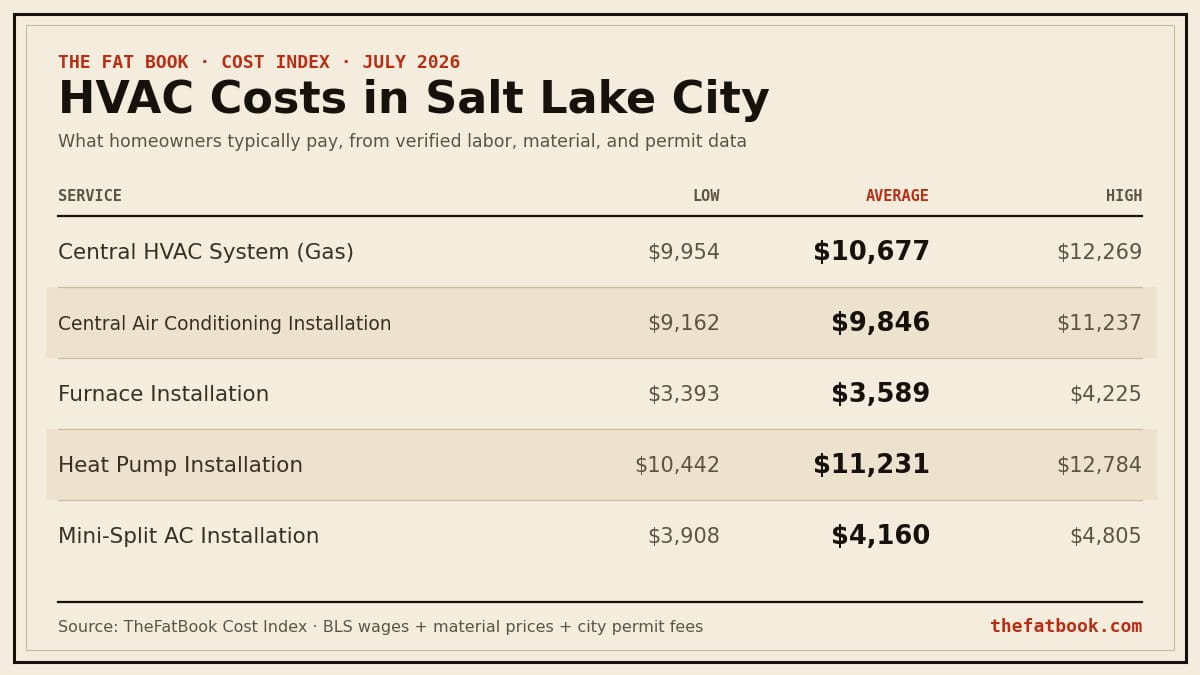
Embed this chart on your site (free, with attribution)
| Service | Low | Average | High |
|---|---|---|---|
| Central Air Conditioning Installation · 3 ton | $9,441 | $10,129 | $11,307 |
| Add AC to Existing Furnace | $8,468 | $9,075 | $9,730 |
| Furnace Installation | $3,516 | $3,713 | $4,250 |
| Mini-Split AC Installation · 1 ton | $4,039 | $4,291 | $4,834 |
| Heat Pump Installation · 3 ton | $10,758 | $11,551 | $12,863 |
| Central HVAC System (Gas) | $11,193 | $11,934 | $12,733 |
| Mini-Split Heat Pump Installation · 1 ton | $4,063 | $4,315 | $4,860 |
| Remove Heating System | $285 | $325 | $369 |
| Baseboard Heater Installation | $746 | $830 | $920 |
| Gas Wall Furnace Installation | $2,464 | $2,627 | $2,803 |
| Hydronic Heating Installation | $11,047 | $11,578 | $13,759 |
| Ductwork Installation | $9,806 | $11,171 | $12,642 |
| Attic Insulation Installation · 1,000 sqft | $2,318 | $2,644 | $2,995 |
| Fiberglass Batt Insulation · 1,000 sqft | $2,602 | $2,967 | $3,361 |
| Blown-In Insulation · 1,000 sqft | $1,990 | $2,269 | $2,570 |
| Rigid Foam Insulation · 200 sqft | $744 | $849 | $962 |
| Whole-House ERV/HRV Installation | $2,835 | $3,028 | $3,341 |
| AC Repair | $255 | $290 | $329 |
| Furnace Repair | $255 | $290 | $329 |
| Multi-Zone Mini-Split Installation | $5,813 | $6,136 | $7,093 |
| Spray Foam Insulation · 1,000 sqft | $2,841 | $3,240 | $3,670 |
| Boiler Installation | $4,626 | $4,934 | $5,535 |
| Whole-House Dehumidifier Installation | $2,458 | $2,581 | $2,927 |
| Wood Stove Installation | $3,737 | $3,947 | $4,525 |
| Pellet Stove Installation | $3,467 | $3,657 | $4,117 |
| Gas Fireplace Installation | $3,279 | $3,460 | $3,962 |
| Chimney Liner Installation | $2,977 | $3,157 | $3,445 |
Before you get bids in Salt Lake City.
Salt Lake City permits.
$12k building fee: $525
$25k building fee: $956
Electrical base: $99
Plumbing base: $75
HVAC base: $89
Source-backed permit facts from PermitCalculator.com and the underlying permits_compiled dataset. Always confirm final requirements with the local building department before filing.