Is your HVAC bid fair?
Ductwork Installation Cost in 2026: The Work Is in the Walls
Chuck Thompson is a retired homebuilder and contractor who owned L.C. Thompson Construction in Jefferson City, Missouri. TheFatBook Cost Index V3 2026 (built from BLS wage and Craftsman labor data) referenced throughout this article is our proprietary dataset that powers all of our calculators and bid-fairness checkers. Full details are on the methodology tab.
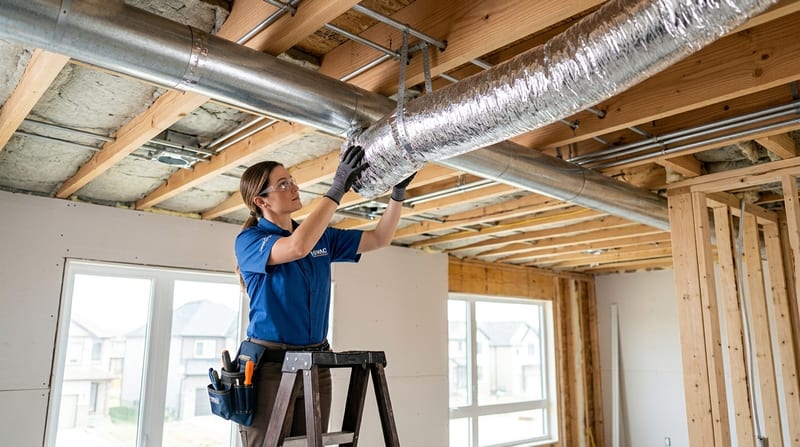
Most HVAC pricing is really equipment pricing. You buy a box, a crew sets it, and the machine is the bill. Ductwork is the exception, and that is the whole story of this page. Our cost index puts a whole-house ductwork installation at $11,195 on average, with most jobs landing between $9,826 and $12,669. The metal in that number is barely a third of it. The rest is days of custom sheet-metal and flex work, run and sealed through attics, crawlspaces, and wall cavities nobody can reach without crawling. You are not buying a thing. You are buying the hours.
Where $11,195 Goes
| Component | Cost | Share |
|---|---|---|
| Material | $3,576 | 31.9% |
| Labor (54 crew-hours) | $2,351 | 21% |
| Permit | $124 | 1.1% |
| Overhead | $2,722 | 24.3% |
| Contractor margin | $2,422 | 21.6% |
| Total | $11,195 | 100% |
Start with the hours, because they are the point. The crew books 36 of them, the better part of a workweek for one installer or a few hard days for two. The HVAC installer earns a base wage near $31.14 an hour. The bid carries that at $43.54 loaded, about 40% above base, which is the cost of the burden behind the body: insurance, payroll tax, the truck the body arrives in. Run those hours at that rate and labor comes to $2,351, a 19% slice. That is high for HVAC, and it is supposed to be. Material is only 31.9%, low for a $11,195 job, because sheet metal and flex duct are cheap stock. Cutting, hanging, and sealing them right is what costs. The $124 permit row is a national allowance only. The real fee is your city's, mapped at permitcalculator.com's HVAC permit page.
Why Ductwork Is a Labor Job
Check your bid Compare your contractor estimate against TheFatBook city pricing, markup, and lowest realistic price data. Run the Bid Checker →
Look across our HVAC index and the labor share tells the whole tale. A mini-split, a furnace swap, an AC replacement: each runs the crew at roughly 9% of the bill, because the work is mostly setting a machine. Ductwork runs 19%, better than double any of them. The same trade, the same wage, wildly different bills, and the difference is hours.
Four things drive those hours. Access is first and worst. The runs live where you do not, threaded through attic joists in July heat and crawlspaces you enter on your back. Second is fabrication. Trunk lines and takeoffs are cut and assembled to fit one house, not pulled off a shelf. Third is sealing, the slow part nobody photographs, where every joint gets mastic or proper tape so the air you paid to condition actually reaches the room. Fourth is design. The ACCA Manual D standard sizes each run to the system, the duct-side companion to the Manual J load calculation. Ducts sized by eyeball move air poorly, and you feel it in the rooms that never get comfortable. These ducts feed the equipment they serve, so a quote here often arrives alongside a central AC replacement. When a home's ducts are truly beyond saving, a ductless mini-split heat pump skips them entirely, which is the one path where this 19% labor problem disappears.
Chuck's Take: Here is what makes ductwork dangerous to buy. Once the drywall closes, the whole job is invisible, and so is whether it was done right. A botched return or a few unsealed joints does not show up as anything you can point at. It shows up as one room that bakes and another that freezes, and a power bill that never quite makes sense. I tell people the same thing every time. Pay for the sealing and the design. The metal is the cheap part, and the cheap part is not what fails you. Leonard "Chuck" Thompson, LC Thompson Construction Co.
What the Quote Should Actually Say
A real ductwork bid is specific in ways a homeowner can check. It should name the Manual D design, not just promise "properly sized" ducts. It should state the total run footage, because footage is what the labor scales with. It should spell out the sealing method, mastic versus tape, since that is the difference between a tight system and a leaky one you cannot inspect later. It should lay out the supply and return layout room by room, because the return side is where corner-cutting hides. And it should be honest about access and whether drywall repair is included, since opening walls to reach the runs is real work that has to land in somebody's column. A bid missing those lines is not cheaper. It is just vaguer.
What Changes City to City
| Metro | Average | Range | Crew labor |
|---|---|---|---|
| Austin | $10,741 | $9,283 to $12,310 | $2,288 |
| Atlanta | $10,504 | $9,192 to $11,917 | $2,164 |
| Denver | $11,690 | $10,190 to $13,306 | $2,701 |
| Phoenix | $11,341 | $9,940 to $12,849 | $2,261 |
| Chicago | $13,015 | $11,573 to $14,568 | $3,440 |
Austin to Chicago is a spread of about $950, and crew labor explains roughly $768 of it. That is a far bigger share than the crew explains in any equipment-heavy HVAC job, and the reason is simple. This is already a labor-heavy job, so when wages climb, the bill climbs with them more directly than it would for a furnace or a condenser. Here the crew carries most of the spread, not the overhead. The company behind the crew, the license and the insurance and the warehouse of duct stock, still costs what it costs in each market, and that moves the number too, just less than the wage line does.
Frequently Asked Questions
How much does ductwork cost?
A whole-house ductwork installation runs into four figures because of the hours, not the metal. Expect material to be about a third of the bill and labor to claim more of it than almost any other HVAC job. Footage, access, and whether the crew has to open finished walls move the number most. When you have a bid in hand, grade it line by line.
Why is ductwork so labor-intensive?
Because the work happens in the worst places in the house. The runs are fabricated to fit, hung through attic joists and crawlspaces, and sealed joint by joint, which is slow and unglamorous and the part that determines whether the system works. That is why our index shows ductwork at a 19% labor share against the 9% of a mini-split. The metal is simple. Putting it where it belongs, sealed, is not.
Do I need a permit for ductwork?
Usually, yes, since ductwork is part of the mechanical system most jurisdictions inspect. Our breakdown carries a flat national allowance for the permit, but that line is a placeholder, not your quote. The actual fee depends entirely on your city, and some scale it to project value while others charge flat. Look up the real number for your address before you treat the permit as settled.
Figures are the national project basis from TheFatBook Cost Index V3 2026 for a whole-house ductwork installation; metro rows reflect local wages and operating costs. Sources: Craftsman National Estimator BOM, BLS OES wages, verified permit fees.