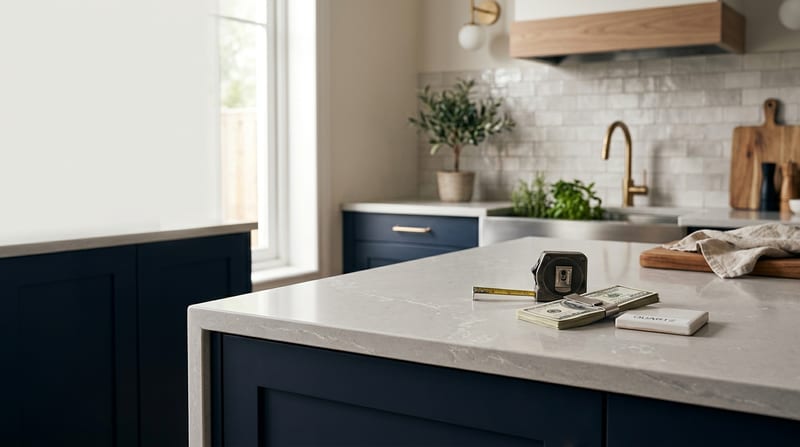
Is your kitchen remodeling bid fair?
Quartz Countertop Cost in 2026: You Are Buying the Slab, Not the Install
Chuck Thompson is a retired homebuilder and contractor who owned L.C. Thompson Construction in Jefferson City, Missouri. TheFatBook Cost Index V3 2026 (built from BLS wage and Craftsman labor data) referenced throughout this article is our proprietary dataset that powers all of our calculators and bid-fairness checkers. Full details are on the methodology tab.
Quartz is one of the few remodeling purchases where the product, not the trade, sets the price. The national average for a standard install of about 40 square feet is $4,523, and most jobs land between $4,045 and $5,037, per our cost index. The bill reads like a service. A crew shows up, templates the cabinets, cuts an engineered-stone slab, profiles the edges, drops in the cutouts, sets it, and seams it. But the biggest line on that $4,523 is the slab sitting in the showroom before anyone touches it. The crew is a thin slice. So the decision that moves your number is the quartz line you point at, not the people who carry it in.
Where $4,523 Goes
| Component | Cost | Share |
|---|---|---|
| Material (the engineered-stone slab) | $2,188 | 48.4% |
| Labor (11 crew-hours) | $419 | 9.3% |
| Permit | $0 | 0% |
| Overhead | $1,070 | 23.6% |
| Contractor margin | $846 | 18.7% |
| Total | $4,523 | 100% |
The crew books about 11 hours across template, fabrication, and set. That covers the trip to measure, the time at the saw, and the day the truck comes back to set and seam. The countertop installer earns a base wage of $28.49 an hour, and the bid carries that body at $38.11 loaded, roughly 34% above base once you add workers' comp and payroll taxes. Insuring someone who guides a heavy slab through a doorway is not cheap. All of that labor adds up to $419, which is 9.3% of the job. That $2,188 material line is not only the slab. It also folds in the edge profiling, the sink and faucet cutouts, and the seaming materials. The permit row is $0 because swapping a countertop is finish work on cabinets that already exist, and almost no city inspects it. The 25% overhead line is the business behind the install: the showroom, the bridge saw, the truck, the insurance on a company that handles expensive stone for a living. Across this 40-square-foot basis, the slab is the biggest line on the bill.
The Slab Is the Lever
Check your bid Compare your contractor estimate against TheFatBook city pricing, markup, and lowest realistic price data. Run the Bid Checker →
Run the labor line in your head across the grades of quartz. Entry-grade or premium, single color or heavy movement, the crew still templates, cuts, profiles, seams, and sets. The saw does the same work either way. Our data carries that out: the fabrication labor on quartz holds at $419 and 11 crew-hours no matter which slab you choose. The number that swings is the material. A plain white quartz and a slab built to mimic deep marble veining can sit a thousand dollars apart on the same kitchen, and that whole gap lives in the material line. None of it is extra work.
The slab you point at has a name, and that name lands somewhere on the material line. Premium engineered-stone lines such as Cambria, Caesarstone, or Silestone sit high, with the heavy-movement, marble-look patterns at the top of those ranges. Builder-grade or value lines such as MSI sit lower, in plainer colors and patterns. Pick high on that ladder and your $2,188 material line climbs. Pick a value color and it eases off.
Thickness is the other slab choice. Quartz comes in 2cm and 3cm. The 3cm is the standard for kitchen counters and can run without a plywood substrate under it, so it is what most kitchens get. The 2cm is thinner and usually needs support underneath or a built-up edge to read as a full-thickness top.
This is also where quartz parts ways with its closest rival, granite. Granite is natural rock, quarried in blocks and sawn into slabs, so every piece is one of a kind. Quartz is manufactured, pressed into slabs from the same recipe, so the pattern runs consistent from one slab to the next. On the material side quartz runs notably higher than granite. The stones differ in what they are and what they cost, and barely at all in the work to set them.
Chuck's Take: Folks come in with a quartz brand and a color already memorized. The slab is the part they study. What nobody asks me is how many seams the layout needs, what edge they want, or whether the cabinet boxes are dead level under there. Quartz is heavy and it does not bend. I have watched a gorgeous top crack along a seam because the cabinets under it had a low spot nobody checked. The slab gets all the attention. The cuts and the boxes underneath are where the job is actually won. Leonard "Chuck" Thompson, LC Thompson Construction Co.
What the Quote Should Actually Say
A quartz quote worth trusting names six things: the slab grade and brand line, the thickness, the square footage, the edge profile, the number of seams, and the sink and faucet cutouts. Those are the items a fabricator genuinely prices. A thicker slab, a fancier edge like a waterfall or a mitered apron, more linear feet of finished edge, an extra cutout, or one big single-piece island will all push the material and the layout up. A bid that just says "quartz, installed" with a single number is hiding the choices that move the price. And none of it matters if the foundation is wrong. The slab only sits as well as the cabinets it lands on, so the kitchen cabinet installation underneath has to be level and solid first. Boxes plumb and sound, then the stone.
What Changes City to City
| Metro | Average | Range | Crew labor |
|---|---|---|---|
| Austin | $4,356 | $3,843 to $4,909 | $414 |
| Atlanta | $4,312 | $3,843 to $4,817 | $414 |
| Phoenix | $4,361 | $3,872 to $4,887 | $381 |
| Denver | $4,765 | $4,236 to $5,335 | $420 |
| Chicago | $4,975 | $4,494 to $5,493 | $643 |
Austin to Chicago is about a $462 swing on the very same counters. Look at the crew column while that happens. It explains roughly half of the swing, about $229, almost all of that the jump to Chicago's wage. Across the other cities it barely twitches. The hours do not change from city to city. A slab is a slab and setting it is the same day's work in Texas or Illinois. What moves the rest is the cost of running a countertop company in that market: the showroom rent, the fabrication shop, the insurance, the price of the stone landed locally. When a Chicago bid comes in over an Austin one, the slab is the same, and the address is most of the reason.
Frequently Asked Questions
How much does a quartz countertop cost?
For a standard kitchen of about 40 square feet, installed, quartz runs in the mid four thousands. Where your number lands comes down to the grade and brand of slab, the thickness, the edge profile, and how many seams and cutouts the layout needs, far more than the labor rate.
What edge profile should I pick?
The edge is its own cost ladder. An eased or beveled edge is the standard, and it is the cheapest because it asks the least of the saw. Step up to an ogee, a bullnose, a mitered apron, or a waterfall and you add fabrication time and per-linear-foot cost, since every one of those takes more shaping on each finished edge.
Is quartz cheaper than granite?
No. Quartz runs notably higher in our data, around half again the granite number, almost all of it on the slab. If you are weighing the two, the granite breakdown lays out that side dollar for dollar.
Does quartz need to be sealed?
No. Quartz is engineered stone, roughly 90% ground stone bound with resin, and that resin makes the surface nonporous. There is nothing for water, wine, or oil to soak into, so it does not take a sealant and never needs the periodic resealing a natural granite top asks for. That maintenance gap is one of the real reasons buyers choose engineered stone over the quarried kind. When you have a quartz bid in hand, grade it line by line before you sign.
Figures are the national project basis from TheFatBook Cost Index V3 2026 for a standard quartz (engineered-stone) countertop installation of about 40 square feet. Metro rows reflect local wages and operating costs. Sources: Craftsman National Estimator BOM, BLS OES wages, verified permit fees.