I'm Chuck Thompson. I founded LC Thompson Construction Co. and spent decades building custom homes and lake houses in central Missouri. I've watched homeowners get fleeced because nobody told them the difference between a "shingle" and a "roofing system." Here's the deal: roof replacement is the priciest maintenance number you'll ever stare down, but do the math right the first time and you won't buy it twice.
Is your roofing bid fair?
How Much Does Roof Replacement Cost in 2026?
A full roof replacement in 2026 runs roughly $9,000 to $18,000 for a standard asphalt shingle roof, or about $4 to $11 per square foot installed. Our own number, from TheFatBook Cost Index, is $14,568 on average for tearing off and replacing a 2,500 square foot asphalt roof, with most jobs between $12,885 and $16,381. We build it from Bureau of Labor Statistics roofer wages, Craftsman labor hours and producer price data for the materials, so every dollar traces to a source. Angi's average runs lower at $9,601 (with a spread from $5,900 to $46,000 for premium setups), and HomeGuide puts the typical job at $5,700 to $16,000. The gap is about what gets averaged: ours prices one defined job, a full tear-off on a 2,500 square foot roof, while the guides' averages blend every size and scope of job their users report. If your roof is that size and the old one comes off, budget toward our number. Roofers price by the square, which is 100 square feet of roof, so HomeGuide's $300 to $600 per square works out to $3 to $6 per square foot. Before you commit, run the numbers.
The Headline Range and What It Assumes
That $9,000 to $18,000 range assumes architectural asphalt shingles on a standard 2,200-square-foot home. Fixr's average is about $4.75 per square foot, anywhere from $3.75 to $11 depending on the material. Most people see the total and panic. But the material is only one slice. You're also paying for the crew, the dumpsters, the underlayment, and the warranty. That range covers shingles, felt, and a standard tear-off of one layer. It leaves out decking replacement, chimney reflashing, and new ventilation, which all show up as their own line items. If your quote comes in under $6,000 for a whole house, somebody is cutting a corner you'll regret the first time hail hits.
Why the National Average Misleads You
National averages give you a starting point. They don't know your zip code or how complicated your roof is. I've bid jobs where the house footprint was tiny, but the roof had four valleys and a 12/12 pitch that demanded specialized safety gear. Those factors alone can double the labor cost. Waste swings it too: every hip, valley and dormer means more cut shingles headed for the dumpster, and you pay for those bundles. You can't just measure the floor and call it a day. The roofing cost by city pages show how far the same job moves between metros.
What Drives the Price: Material, Pitch, and Square Footage
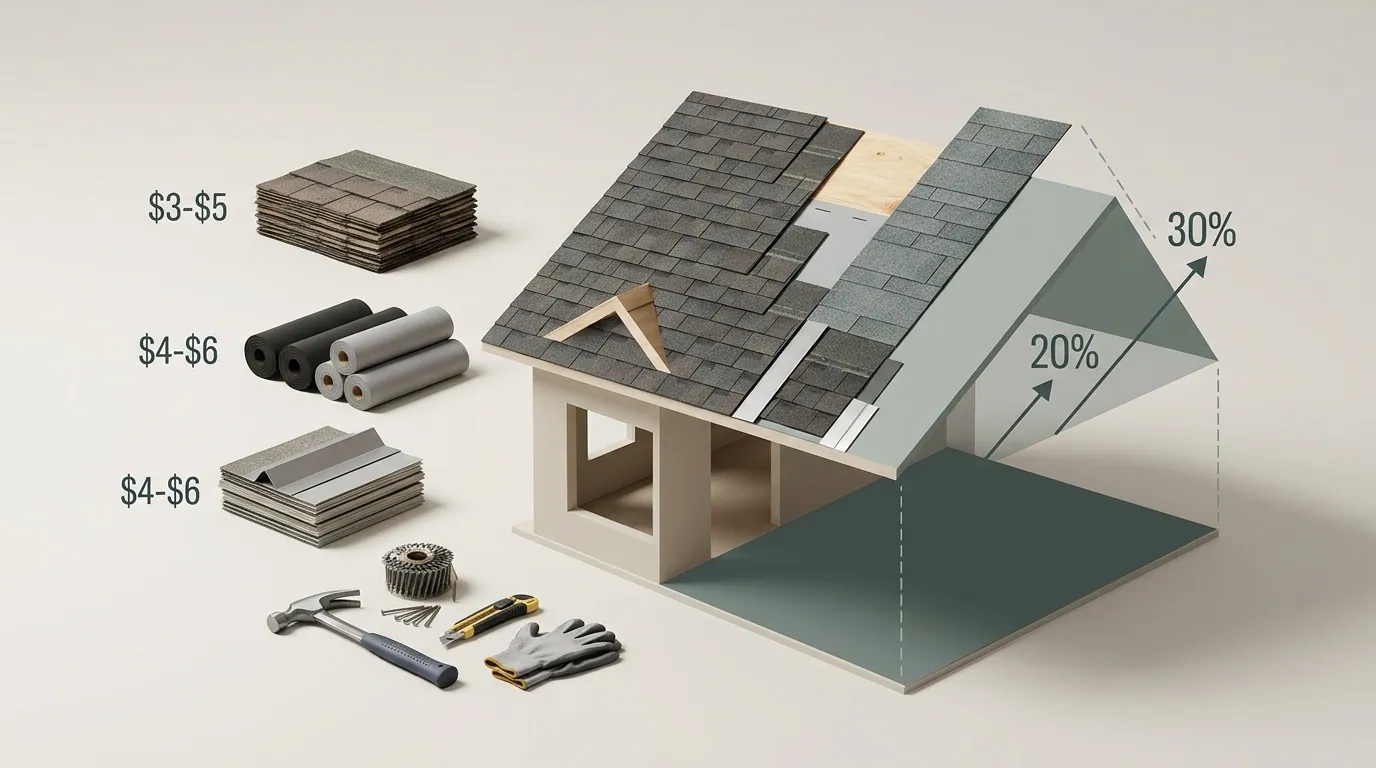
Material is the biggest lever you can pull on your bottom line. I've watched guys chase savings with the cheapest 3-tab shingle on the shelf, and it's a wash in the long run. Your roof is usually 20% to 30% larger than your home's footprint once you count pitch and overhangs, as Modernize points out. So if you've got a 2,210-square-foot home, the median size for a single-family house in 2024, your actual roofing surface sits closer to 2,700 square feet.
Installed Price by Roofing Material
| Material | Installed Cost per Sq. Ft. |
|---|---|
| Asphalt 3-Tab | $3-$5 |
| Architectural Shingle | $4-$6 |
| Metal (Steel/Aluminum) | $5-$16 |
| Natural Slate | $10-$30 |
(Data source: HomeGuide, 2026)
Pitch and Roof Surface vs Home Footprint
A steep roof costs more for plain reasons: the contractor pays more to insure the crew, and the crew moves slower. NerdWallet reports a steeply sloped roof can add $1,000 to $3,000 to the job. If my guys can't walk the roof without ropes and harnesses, the labor hours double. I once had a client who couldn't figure out why his "simple" Victorian cost 40% more than his neighbor's ranch. The neighbor's roof was flat enough to play cards on. His needed a crane just to stage the bundles.
Labor, Tear-Off, and the Line Items Contractors Bundle
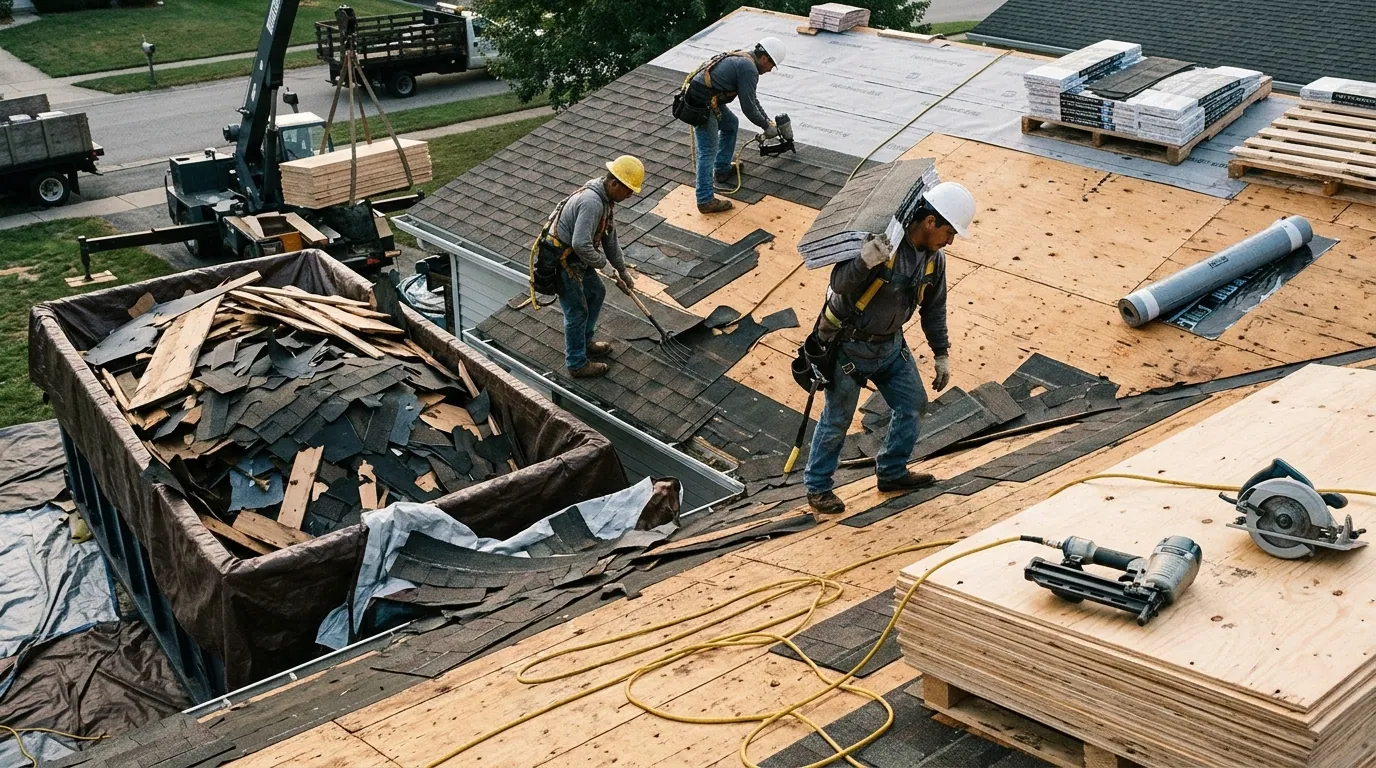
You aren't just buying shingles. You're buying a logistics operation: a tear-off crew, a dumpster, deliveries timed to the weather. In This Old House's 2026 survey, labor was the largest cost factor at 65% of the total roofing project.
The Labor Share of Your Bill
Labor eats most of your money, and it's where the best contractors set themselves apart. Figure labor at half to 60% of the bill, about $2.50 to $6.00 per square foot (Modernize's range), and roofers at roughly $40 to $90 an hour per worker (Angi). That hourly rate carries workers' comp, general liability, and the gear that keeps a crew from sliding off your rafters, which is why it runs higher than the guy who mows your yard.
Tear-Off, Disposal, and Underlayment
Don't let a contractor talk you into "roofing over" the old shingles to save a buck. Tear-off and disposal run about $50 per square and up to $150 for heavy stuff like concrete tile or stacked layers of asphalt (Fixr), and our index prices a full tear-off on a 2,500 square foot roof at $3,112 on average. Leave the old stuff on, and you trap heat while piling thousands of pounds of dead weight onto your trusses. I always insist on a clean deck. It's the only way to check the sheathing for rot before new underlayment goes down. Look for that line item on every quote.
Do You Need a Permit to Replace a Roof?
Yes. Most municipalities require a permit for a full roof replacement, typically $100 to $500 depending on your city and how the local building department calculates the fee. That range is Fixr's. On PermitCalculator's city data, a reroof permit runs from $76.50 in Philadelphia to $748.69 in Detroit, around $172 in the typical city, and 17 cities, Chicago, New York and Phoenix among them, charge nothing for a straight reroof. I've pulled permits in towns where the inspector just wants to see the shingle wrapper. Elsewhere, they'll climb the ladder to check your nailing pattern.
Permit Fees and Inspection
Permit costs usually track the total value of the job or a flat fee per square. A post-work roof inspection runs around $240 (Angi), usually its own line item if you hire a third party to check the contractor's work. Skip the permit to pocket a few hundred bucks and you're buying a headache when you sell the house. Title companies and sharp buyers check for recorded improvements. No paperwork, and you might be tearing off a perfectly good roof just to prove to the city it was done to code.
Hidden Repairs Found After Tear-Off
The permit is the cheap part. The real spikes hit once the old shingles are in the dumpster and we see what's underneath. Fixr's numbers: new roof decking at $2 to $8 per square foot, fascia and soffit repairs at $500 to $2,500, and serious rafter damage adding up to $5,000. Nine times out of ten, the rot I found hid along the north slope and the valleys, where snow and shade keep the deck damp long after the rest dries out. I've watched homeowners go pale when I show them a rotted ridge beam that looked fine from the attic. You can't slap new felt over soft plywood. Our roofing methodology shows how we tally these line items, so the change order doesn't blindside you.
Asphalt vs Metal: A Cost-Over-Time Walkthrough
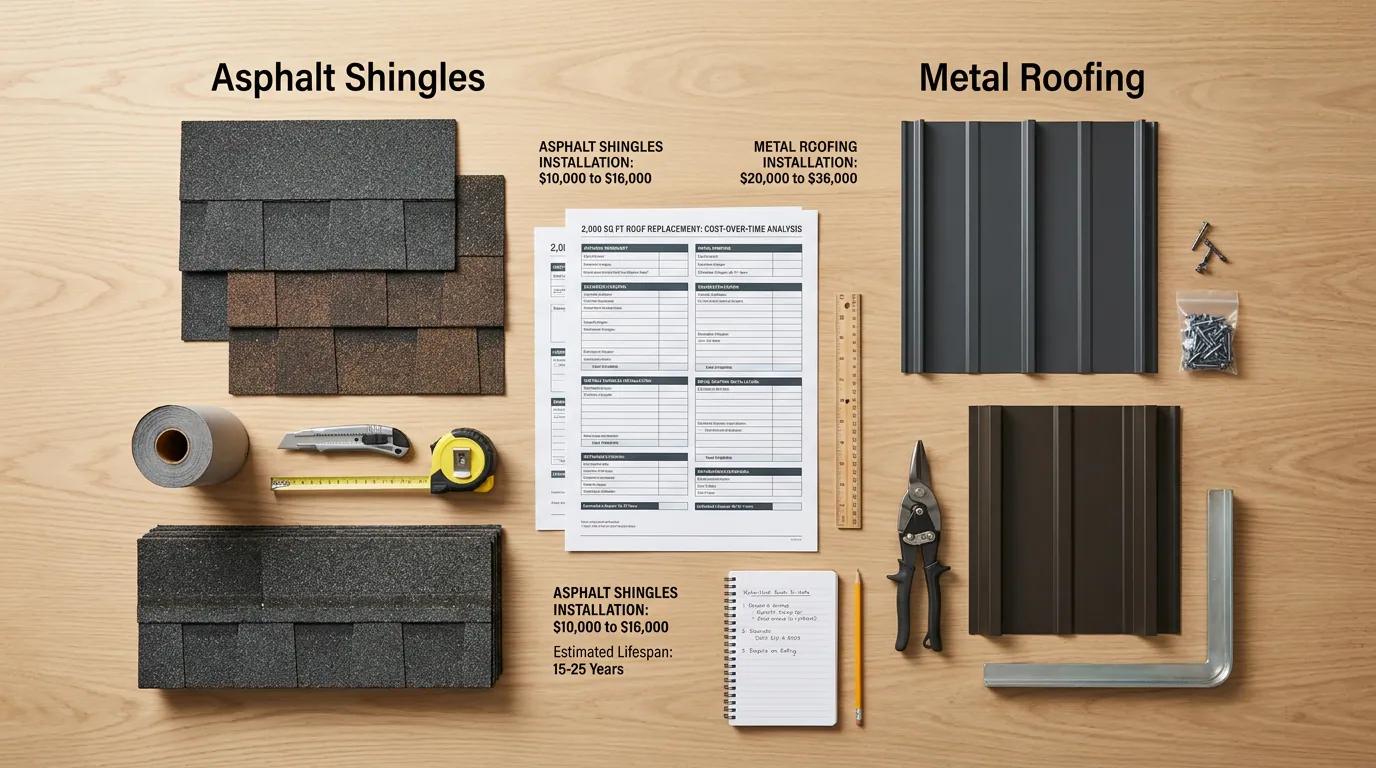
Planning to stay in the house thirty years? The material math looks nothing like it does on a fix-and-flip. PITCH Roofing illustrates a 2,000-square-foot job at $10,000 to $16,000 in asphalt versus $20,000 to $36,000 in metal, roughly double. Our index lands in the same place: $34,964 on average for a 2,500 square foot metal roof against $14,568 for asphalt. That upfront sticker shock is real. But a roof isn't a one-time buy when the material wears out before your mortgage does.
Upfront Price on a 2,000 SF Roof
For a standard 2,000-square-foot roof, Modernize suggests asphalt may total $8,000 to $16,000, split roughly $3,500 to $7,000 for materials and $4,500 to $9,000 for labor. Metal systems need specialized tools and more time for precision cutting around valleys and hips, and that's where the labor gap comes from. You're paying for a crew that understands expansion and contraction, not just guys with nail guns.
The Lifespan Math That Changes the Answer
The real value shows up at the two-decade mark. Metal roofs last 40 to 80 years against about 20 for asphalt shingles, by State Farm's numbers. Put asphalt on today and you'll likely be paying for a second tear-off and replacement while your neighbor's metal roof is still in its prime. And by the time you need that second roof, labor and material costs will have climbed with inflation. One metal roof outlasts two-plus asphalt jobs. So the "metal pays for itself" line only holds if you own the house long enough to dodge that second bill.
How to Read a Roof Replacement Quote
Treat the quote like a legal contract, not a suggestion. I've seen guys scrawl "New Roof" on the back of a business card and expect a deposit. Don't do it. A professional quote should be a multi-page document that accounts for every vent, flashing, and nail. Before you commit, plug your measurements into the roofing calculator to see if the contractor's square footage matches yours.
Line Items Every Quote Should Spell Out
- Confirm the surface footage. The quote should state roof surface square footage, not living-space footage.
- Check the tear-off line. Tear-off, disposal, and dumpster fees should be itemized.
- Verify the underlayment. Underlayment and flashing should be specified by brand and type.
- Name the permit handling. Permit and inspection responsibility should be spelled out.
- Separate the warranties. Look for the workmanship warranty separate from the manufacturer warranty.
- Get three bids. Collect at least three quotes on identical material and scope.
Angi puts contractor workmanship warranties at $500 to $2,000 and manufacturer warranties at $500 to over $5,000. Know which one you're paying for.
How Many Bids and What to Compare
In This Old House's 2026 survey, 20% of homeowners said they would get more contractor estimates before starting. Don't join the group that regrets rushing. Compare crew size, schedule and materials line by line, and ask each roofer what his warranty covers. If one bid lands $4,000 below the others, he's probably skipping the high-quality underlayment or running a crew without insurance.
Frequently Asked Questions
What a roof replacement costs comes down mostly to material, roof size, tear-off difficulty, and local labor rates. On a 2,500 square foot roof, TheFatBook Cost Index puts most asphalt shingle jobs between $12,885 and $16,381 and metal at $30,913 to $39,328 in 2026.
Steeper roofs, multiple valleys, rotten decking, or a second layer that has to come off can push the price up fast. Flat roofs often cost less per square foot than tile or slate, though details like drainage and membrane type still matter.
Insurance changes the answer completely if wind or hail caused the damage. In that case, many homeowners pay only their deductible. For an exact quote, a contractor needs roof measurements, photos of the current condition, and a walkthrough of any flashing, chimney, or ventilation work that has to be included.
How much does it cost to replace a 2,000 square foot roof?
A 2,000-square-foot asphalt roof typically lands around $8,000 to $16,000 installed, while the same roof in metal runs roughly $20,000 to $36,000. These figures include the standard tear-off of one layer plus new underlayment and shingles. The price moves with the complexity of your roof's hips and valleys.
Does homeowners insurance cover roof replacement?
Insurance generally pays only when the damage comes from a covered sudden event like a storm or fallen tree, not age or wear. If your roof is 25 years old and leaking because the shingles are brittle, that's maintenance, not a claim. And unpermitted prior work can give an insurer grounds to deny the claim outright. They want proof the roof was built to the standards they're insuring.
When should you replace a roof instead of repairing it?
A common rule: if a repair costs 50% or more of a full replacement, replace the whole roof. Watch the "balding" of the shingles, too. Past 20 years, leaking in multiple spots, or losing shingles across large areas, and a patch won't save it. I tell people to look in their gutters. Full of granules means the shingle's protection is gone.
Can you install a new roof over the old one?
An overlay skips tear-off and saves on labor and disposal, but most codes allow only one extra layer, and never over wet or damaged decking. It's a shortcut that backfires. It can hide rot and shorten the new roof's life by trapping heat. Plenty of contractors won't touch it, because they can't warrant work when they haven't seen the wood underneath.
Why are 2026 roof quotes higher than older online estimates?
Material costs, tariffs on imported components, and a tight skilled-labor supply have shoved quotes above older guide figures. Modernize warns that tariffs and supply-chain shifts can move a quote, so ask whether recent changes affected yours. Everything on the jobsite costs more than it did three years ago.