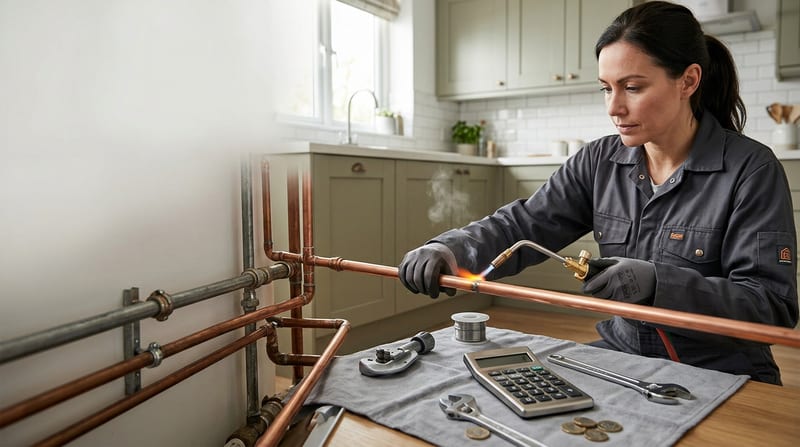
Is your plumbing bid fair?
Plumber Cost Per Hour in 2026: Labor Rates, What Drives Bids, and How to Get a Fair Quote
If you're researching what a plumber charges per hour, here's the straight answer: $75 to $200, and the spread is where the real story hides.
So you're wondering what a plumber really charges per hour. I'll tell you what most pricing sites won't: there's no independent methodology behind the national averages you see online. Search results are just local contractor pages and forum threads. The most recent Bureau of Labor Statistics Occupational Employment and Wage Statistics release (based on May 2025 wage data) put the median annual wage for plumbers, pipefitters, and steamfitters at $71,800. Do the rough math and that's about $31 an hour, before you add overhead, insurance, tools, or a profit margin. No one hires a plumber for thirty-one bucks an hour. But that baseline number is useful. It shows what the labor itself actually costs before all the other markups get layered on.
Plumber cost per hour: what you can expect to pay in 2026
The national median wage tells you one thing. What you actually pay tells you something completely different.
That $71,800 figure from the Bureau of Labor Statistics excludes self-employed workers, agriculture workers, and private household workers. It's a pure labor input cost. Your billable rate, by contrast, bundles in travel, diagnosis, insurance, tools, profit, and overhead. According to HomeAdvisor's 2025 to 2026 service cost data, the typical range homeowners see is $75 to $200 per hour. The spread depends on region, job complexity, and company size. Fair warning though: the hourly rate alone almost never tells the full story.
The real hourly number is blended labor plus minimum trip time
A plumber quotes $125 an hour. But that number means little without context. You're paying for travel time to and from the job, for diagnosis before a wrench touches a pipe, for the actual repair or installation, for cleanup, and for invoicing. Most legitimate companies also charge a minimum service call fee covering the first hour or two. Whether the job takes fifteen minutes or ninety, that minimum applies. So when comparing numbers, you're really comparing what two different companies include.
How license level changes what you're actually buying
Plumbing license structures vary significantly by state, and those differences directly affect what you pay. Texas, through the Texas State Board of Plumbing Examiners (TSBPE), recognizes four plumbing license types: Tradesman Plumber-Limited, Journeyman, Master, and Plumbing Inspector. A Journeyman can install, change, repair, service, or renovate plumbing, but only under the supervision of a Responsible Master Plumber. That supervision layer shows up in what you pay.
California takes a different approach: the state issues a single C-36 Plumbing Contractor license through the Contractors State License Board, with no formal journeyman or master tier distinction at the state level. Meanwhile, states like Pennsylvania and Missouri have no statewide plumbing license requirement at all; licensing is handled at the municipal level, which means the credentials (and the cost structure) of the plumber you hire in Pittsburgh may look nothing like what you'd get in a rural county an hour away.
The takeaway: you're not just buying labor. You're buying the legal right to have that work performed by someone credentialed to do it. The tier of who holds the wrench, and how your state structures oversight, changes the per-hour price more than most pricing sites acknowledge. For the rest of this article, I'll reference the Texas TSBPE framework as a concrete example of how tiered licensing works, since it's one of the most clearly structured systems in the country.
Job types that change the per-hour math fast
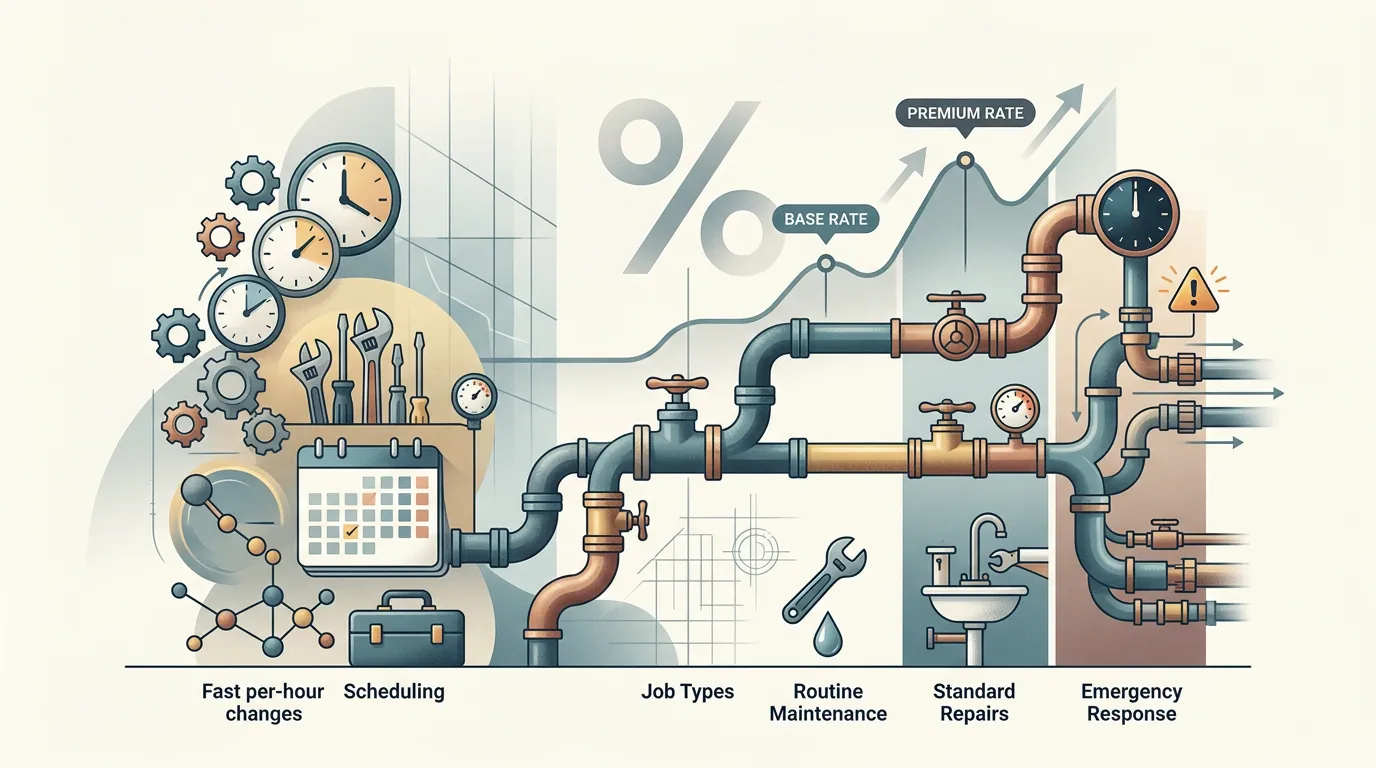
That quote you got? By itself, it's useless. The same plumber at the same hourly rate will produce drastically different bills depending on the work. The Federal Trade Commission's guidance is straightforward: get three written estimates, each detailing the work, materials, completion date, and price. Solid advice, because job type is the variable that swings your total most.
Service calls: diagnosis time often costs more than the fix
A running toilet or a slow drain might only need $75 in parts. But diagnosis takes time. A plumber runs a camera, traces the line, tests pressure, isolates the problem. Most homeowner "emergencies" are flapper failures and P-trap clogs. The U.S. Environmental Protection Agency says most toilet leaks come from old or worn-out flappers. If the diagnostic finds something worse, like a sewer line defect, the EPA notes that blockages, line breaks, and groundwater infiltration cause overflows that back up into homes. So diagnosis drives your cost before repair even starts.
Repairs with access work: closures, reroutes, and re-testing
A leak behind a tiled shower wall isn't the same animal as a supply line replacement under the sink. Access work means opening drywall, removing finishes, routing around joists, then closing everything back up to code. The plumber quoting $150 an hour might spend three hours on access and thirty minutes on the fix. That's not padding the bill. That's how walls work. Some companies itemize this as a separate labor category. Others bake it into the flat rate. Either way, you're paying for it.
Install work: rough-in and final connections add separate labor blocks
New construction or a full remodel means two labor phases: rough-in and final. Rough-in is the supply and drain work done before walls go up. Final is trim-out, fixture connections, and testing. In practice, the install has a supervision component that adds overhead. What does a straight hourly quote tell you? Nothing about whether the rate includes both phases or just one.
What drives plumber bid pricing beyond the hourly rate
An hourly quote tells you almost nothing about what you'll actually pay. The billable rate your plumber charges is a blended number that packages travel, diagnosis, skilled install, cleanup, and documentation into one line item. On top of that, materials get marked up from supply house pricing. A fair bid spells out materials and labor separately, and that transparency is exactly what protects you.
Labor buckets: travel, diagnosis, skilled install, cleanup, and documentation
Some companies quote a single flat hourly rate. Others break labor into categories: travel time billed at a lower rate, diagnostic work at full rate, skilled install at premium rate. The end result is roughly the same total, but the structure tells you what the company values. I've seen outfits charge separately for travel and then discount the repair labor. I've also seen companies roll everything into one number that looks clean on paper but hides where the money goes. A good contractor explains the breakdown. In tiered-license states, the license level of who's on site matters here; when a Journeyman does the work, the Responsible Master Plumber's oversight is part of the cost.
Three bids on the same kitchen repipe routinely come back with three completely different structures. Take a copper-to-PEX job, about 60 feet of run through a single-story slab home in a higher-cost market. One shop bids a flat $4,800. Another quotes $175/hour with a 20-hour estimate ($3,500 labor) plus $900 in materials. A third quotes $145/hour but estimates 28 hours ($4,060 labor) plus $750 in materials. Same job, same house, three different structures. The flat bid can't tell you what happens if the crew hits a slab obstacle. The $175/hour bid with a clear scope and a contingency line for slab access is the one worth taking, not because it's cheapest, but because the labor buckets are visible.
Materials and markup: why line items still matter per hour
Every plumber marks up materials, and that markup compounds whatever hourly rate you're quoted. Plumbers buy fittings, pipe, valves, and fixtures from supply houses at pricing well below retail. The markup from supply house cost to what you see on the invoice typically runs 20 to 40 percent. That's not a rip-off. It covers inventory carrying costs, warranty handling, and the overhead of keeping materials on the truck. The key is transparency. If your bid lumps materials into a single line item with no breakdown, you're left guessing at what the markup actually is. A detailed, accurate bid gives you leverage to negotiate. A bid that hides the material cost usually hides something else too.
I learned this the hard way on a rural Missouri job: no state license requirement, small outfit, one-line bid. The "materials" charge on a water heater swap was $400 above what the unit cost at the local supply house. When I asked for a breakdown, the plumber couldn't produce one. That $400 gap was paying for something, but neither of us could say what. The lesson isn't that the markup was wrong; it's that a one-line bid leaves you nothing to push back on, and a plumber who can't itemize a $400 charge either doesn't know his own costs or would rather you didn't.
How do you compare plumber hourly bids without getting fooled?
Three quotes sitting in front of you, each structured completely differently. You need a checklist to force an apples-to-apples comparison. Per the FTC, each estimate should detail the work, materials, completion date, and price. That's your starting line. Here's the two-step filter I use.
First, demand a scope checklist so hours have boundaries, not vibes. Second, ask who supervises the work and which license level will be on site.
Use a scope checklist so hours have boundaries (not vibes)
A scope checklist is your insurance against open-ended hours. Write down every task: access work, repair steps, cleanup, inspection prep. For each item, get the estimated hours and the hourly rate. In Texas, for example, an apprentice may only assist under direct supervision and without a licensed plumber present may only do manual tasks like trench digging. So if the bid includes apprentice labor, note what they're doing and at what rate. That checklist turns a vague "8 hours" into specific, bounded tasks you can compare line by line.
Ask who supervises the work and which license level will be on site
According to the U.S. Bureau of Labor Statistics, most states require plumbers to be licensed. That license tier affects who does the work and who signs off. So ask directly: Will a Journeyman be on site? Is the Master Plumber available for inspection? The bid might quote a lower hourly rate, but if it's an apprentice working alone, that's a red flag. Supervision isn't optional in states that require it, and it directly changes the cost structure.
How apprentices, journeymen, and masters show up in hourly pricing

Here's how the tiers play out on a typical 50-gallon gas water heater replacement quoted with a two-man crew. The apprentice's time is billed at $65 an hour; the Journeyman is billed at $125. The estimate calls for two hours of apprentice prep, disconnecting the old unit, draining it, hauling it out, and two hours of Journeyman install time for the new unit, connections, and testing. That pencils out to a $380 labor bill plus an $85 service call fee: $465 total before the heater and materials.
Here's how that same invoice goes sideways. The apprentice spends four hours on the prep because the old unit is corroded to the platform and the gas flex line fitting is seized. The Journeyman arrives, finds the flue vent isn't to code, and spends an additional hour reworking it before the install can even start. Final labor invoice: $635 ($260 apprentice, $375 Journeyman) plus the $85 service call. With the water heater ($1,100), expansion tank, new gas flex, and fittings ($185 in materials), the total lands at $2,005 on a job budgeted around $1,500.
The lesson isn't that anyone overcharged; every hour is legitimate work. The lesson is that the apprentice's lower rate looks like a deal on paper, but a slower pace on a complicated removal eats the savings. And the Journeyman's code correction is necessary but isn't in the original scope. A tighter scope checklist with a "condition unknown" contingency line sets better expectations from the start.
Apprentice work counts as labor, but it needs direct supervision
An apprentice is learning the trade. They can do manual tasks, but they must be supervised. That supervision time is part of the cost. If an apprentice takes three hours to do what a Journeyman does in one, you're paying for three hours of apprentice labor plus the Journeyman's oversight. So ask: how much of the job is apprentice labor, and at what rate?
Journeyman work shifts responsibility and can raise the blended rate
A Journeyman can work independently on most tasks, but they still operate under a Master Plumber's license. That means accountability. The Journeyman's rate is higher because they carry more liability. When you see a blended rate, check the mix. A bid with 80% Journeyman hours and 20% apprentice hours is different from one that's the opposite.
Master level supervision affects accountability and bid structure
The Master Plumber is the one whose license is on the line. They may not be on site every minute, but they're responsible for the work. That oversight is part of the bid cost. If your job requires a permit, the Master Plumber's name goes on it. Their rate reflects that liability. A bid from a company with a Master Plumber on staff will often be higher, but it's the one that passes inspection.
Rules of thumb for your next plumbing quote in 2026
Your next plumbing quote should be a contract, not a conversation. Here are two rules I follow.
Tie the payment to measurable milestones, not "time and materials" alone
Time and materials is a blank check. Instead, break the job into clear milestones: rough-in, inspection, finish. Pay a percentage at each stage. This forces the plumber to hit benchmarks before getting paid. Big difference.
Make sure milestone payments reflect the license level doing the work. If an apprentice handles the rough-in, the payment should match that rate. Milestones keep the job moving and protect your budget.
Run the numbers before you sign, then verify scope and permit steps
Before you sign anything, compare the quote against your own research. Run your job through our plumbing cost calculator first. A water pipe replacement in Houston, for example, prices out at $2,380 on average, with a fair range of $2,077 to $2,616. Bids that land far outside that band need an explanation: the high one has to justify its scope, and the low one is probably missing some. That kind of sanity check takes five minutes and can save you hundreds.
Check the scope against local permit requirements. A licensed plumber pulls permits and schedules inspections, that's part of the value you're paying for. A simple Kohler flapper replacement is a ten-minute job, but if it's part of a larger bathroom remodel, the permit steps matter. Verify the quote includes those fees and inspection time. Review our methodology to see how we break down costs.
How much does an emergency plumber charge per hour?
Emergency work typically runs $150 to $350 per hour, roughly 1.5× to 2× the daytime rate, because of after-hours dispatch, overtime pay, and longer diagnosis blocks. A burst supply line at 10 p.m. on a Saturday, for example, might generate a $150 to $250 flat dispatch fee before the hourly clock even starts, plus two to three hours of on-site labor at the overtime rate. According to HomeAdvisor's 2025 to 2026 service cost data, the average emergency plumbing visit totals $400 to $800 depending on the repair. Ask for a flat emergency dispatch fee quoted separately from the hourly rate so you know the fixed cost upfront and can bound the rest by time on the repair.
What should be on a plumbing estimate before work starts?
Beyond the four FTC basics, what separates a usable estimate from an exposed one is specificity. The work line should read "replace kitchen faucet supply valve," not "fix leak." Materials should list brand and model, not just "fittings." And labor and materials belong on separate lines, because a single lump sum is where the markup goes to hide.
Does hourly pricing include permit and inspection time?
Sometimes. Some contractors fold permit and inspection time into the hourly rate; others bill it separately. The trap is leaving it unstated. If the plumber calls the permit extra, get the exact fee before you sign. If they call it included, get that in writing. The permit is what makes the work inspectable and code-legal, so it is never the line to treat as an afterthought.
Sources
Wage data: Bureau of Labor Statistics Occupational Employment and Wage Statistics (May 2025 release), https://www.bls.gov/oes/. Material price trends: FRED producer price indexes, https://fred.stlouisfed.org/. Full FatBook methodology: https://thefatbook.com/plumbing/methodology/.