
How Much Does HVAC Cost in Portland?
This price is for a standard AC Replacement in Portland. See other HVAC service prices ↓
That is the modeled cost to deliver plus a fair contractor margin, not a sales quote. Built from BLS metro wages, Craftsman labor hours, a real bill of materials, and hand-verified permit data. 2026-08-28
This is a central AC installation: a new condenser, coil, and lineset that reuse your existing furnace blower and ducts. It is cooling only, not a whole new system. Replacing the furnace and AC together as one gas system is the step up, a furnace-only swap the step down, and major duct rework is priced on its own.
Show the math
The margin is the gap between break even and a typical quote, not a markup we invent. Fair margin moves with trade and market. Most land at a 15 to 22 percent margin on the bid, roughly 18 to 28 percent over the cost to deliver, and free labor does not exist. Full methodology.
Is your HVAC bid fair?
Calculate your Portland true cost.
Show the math: how Portland Central Air Conditioning Installation numbers are derived Click to expand
What you pay for in Portland.
Every HVAC dollar in Portland, split into labor, materials, permit, overhead, and the contractor margin. The first four are the cost to deliver. On top of that sits the margin a fair job earns.
See cost by project size
What central air conditioning installation costs at your size.
Priced at the standard ton sizes. Pick the one that matches your system.
| Size | Typical | Range |
|---|---|---|
| 2 ton | $7,707 | $7,206 to $11,877 |
| 3 ton | $10,543 | $9,858 to $16,247 |
| 5 ton | $13,537 | $12,657 to $20,861 |
Scaled from TheFatBook's per-size cost model, the same one behind the calculator.
Heat pump, furnace, or mini-split?
The three system types most Portland homes weigh, with real local install cost. Pick by your climate and whether you already have gas and ductwork.
- Heats and cools in one system
- No gas, very efficient in mild winters
- Highest upfront cost
- Leans on backup heat in deep cold
- Strong, cheap heat in hard winters
- Lower upfront than a heat pump
- Heating only, you still need AC
- Burns gas and needs venting
- No ductwork required
- Zone each room on its own
- One indoor head per zone adds up
- Wall units are visible
Portland HVAC costs run $7,707 on average for central air conditioning installation. That sits 22.8 percent below the national average of $9,987. I found this spread while building the index from local wages, tracked material prices, verified permit fees and Craftsman labor hours. The floor sits at $7,206. This page shows exactly where that number comes from and how to tell if your bid makes sense.
Numbers on this page come from Craftsman labor hours, BLS OES May 2025 wages for Portland, FRED material prices, and the verified local permit fee. Population, income, home values and housing age come from the U.S. Census Bureau (QuickFacts and the American Community Survey); unemployment from the BLS Local Area Unemployment Statistics; building permits from the Census Bureau via FRED. How we calculate
Local Market
The city average for central air conditioning installation in Portland is $7,707 (TheFatBook cost index, 2026). That's 22.8 percent below the national average. Urban growth boundary restrictions heavily favor remodeling over new builds. This creates intense demand for specialty renovation contractors and keeps local HVAC prices firmer than you might expect from the lower wage baseline. Portland's BLS wage input shows $34.95 per hour base for HVAC techs. Add the 40 percent burden and you get a loaded rate of $48.93 per hour. So TheFatBook Cost Index uses 16 Craftsman hours at that loaded wage to reach $783 in labor. Materials add $4,240 from FRED PPI data. The local unemployment rate sits at 4.2 percent. Recent population decline of 2.7 percent should ease contractor demand but the remodeling squeeze from the growth boundary offsets it. Median home value of $581,500 supports solid renovation budgets. Portland's rainy season limits exterior work to May through September. Wildfire smoke can still shut down outdoor crews in late summer. Shop in the shoulder months if you can. The numbers show Portland delivers HVAC work cheaper than most big cities but not by much once you factor in the specialty labor pull.
Portland sits at about thirty five bucks an hour base for HVAC guys. That's decent but the growth boundary keeps pushing remodel work so crews stay busy. The population drop should have loosened things up. It hasn't. Those remodeling contractors are booked. Call it a tight supply no matter what the unemployment rate says. What's your contractor telling you his schedule looks like next month?
Understanding Your Bid
The average Portland bid for central air conditioning installation lands at $7,707 (TheFatBook cost index, 2026). And honestly, the verified floor is $7,206. That leaves $501 of potential savings between the average and the lowest realistic price. Contractor margin comes in at 18.6 percent. This is calculated as the spread between the $7,707 average and the $6,276 cost to deliver divided by the average. Not every bid above the floor is gouging. Some contractors simply carry higher overhead or book more buffer. I ran the numbers through TheFatBook Cost Index. The cost to deliver sits at $6,276. That covers burdened labor, materials, the $171 permit and overhead allocation. Anything above that's margin. The high end reaches $11,877. That isn't automatically a ripoff but it deserves hard questions about what exactly is included. Portland bids cluster tighter than national ones. Still the spread from the $7,206 floor to the $11,877 high is wide. Know where your number sits.
Check your bid against these numbers →
Cost Breakdown
$6,276 is the cost to deliver a central air conditioning installation in Portland (Craftsman, 2026). That figure comes straight from TheFatBook Cost Index. It breaks down to $783 in labor from 16 hours at the $48.93 loaded wage. The base BLS wage is $34.95 per hour. Add the 40 percent burden for taxes, insurance and benefits and the math lands exactly on $783. Materials add $4,240 according to FRED PPI inputs. The verified permit fee is $171 from PermitCalculator.com. Overhead allocation from NAHB benchmarks is $1,082. Direct costs total $5,195 before overhead. Portland's deconstruction ordinance requires whole houses built in 1940 or earlier to be hand-dismantled when they are demolished, but a straight HVAC replacement is not a demolition, so that cost should not touch your quote. Oregon's energy code requires heat pumps on new construction, and many Portland homeowners choose one on replacement too. A heat pump averages $8,810 here against $3,924 for a furnace alone. So the floor of $7,206 sits above the cost to deliver. It represents the lowest realistic out-the-door price after a lean sustainable margin for this market. The 18.6 percent contractor margin lives in the gap between delivery cost and average. Not every line item on your bid will match these exact inputs but the totals should feel close.
Sixteen hours for a central air install sounds about right to me. I've seen crews take longer when they're brazing a copper line-set on a hot day or pulling a vacuum on the compressor. The labor cost at roughly forty nine an hour loaded is honest. But watch the materials line. That four thousand dollar number is what the supply house charges the contractor. He's betting you won't check it.
How to Negotiate
$501 separates the Portland average of $7,707 from the floor on central air conditioning installation. That's real money. Urban growth boundary restrictions create steady remodeling demand so contractors aren't desperate. Shop in the shoulder months before the rainy season or wildfire smoke hits. Know exactly where your bid sits against the $6,276 cost to deliver. Ask for an itemized breakdown that shows labor hours, material suppliers and the permit fee. Don't lead with the floor price. Tell the contractor you've run the numbers against local data and want to understand any gap above the $6,276 cost to deliver. Portland's median household income of $85,876 supports decent budgets but homeowners here hate surprise upcharges. Get the heat pump question settled up front.
Ask the contractor straight up how he's handling the new Oregon heat pump rule on your job. That one question separates the guys who know the code from the ones who will bill you later. Portland shoulder months give you the best shot at an honest price. In Missouri we just waited until after the July heat broke and the bids always came in softer.
Price your own job in Portland →
What Makes This Market Different
Portland is the only major city where the urban growth boundary and an older housing stock team up to make HVAC replacements feel like a custom job even when they aren't. The growth boundary heavily favors remodeling. That squeezes specialty crews and keeps the average central air job at $7,707 instead of something lower. Oregon's energy code requires heat pumps on new construction, and many homeowners choose one on replacement, and a heat pump averages $8,810 here against $3,924 for a furnace swap. The central air average on this page prices AC only. Homes with a median build year of 1966 often hide knob-and-tube wiring or undersized panels once the walls open. Your quote can climb well past the $7,707 average if the crew hits those. The $171 permit is straightforward but the manual tear-down rules for pre-1940 houses inflate every demo phase. I built TheFatBook Cost Index expecting Portland to land softer because of the rainy season slowdown. Instead the remodeling pressure and code rules keep prices closer to national levels than the raw wage data suggests. The floor of $7,206 is still the lowest realistic price but it assumes a clean house and an efficient crew. Hands down. But most Portland jobs aren't that clean.
Frequently Asked Questions
How much does central air conditioning installation cost in Portland?
Is my HVAC bid fair in Portland?
How much does a furnace installation cost in Portland?
Why do HVAC quotes in Portland often require heat pumps now?
TheFatBook models HVAC from Craftsman labor hours, BLS regional wages, burden, PPI-adjusted materials, permit data where available, and contractor overhead benchmarks. Cost index version: 2026-08-28. Updated Aug 2026.
Sources & methodology for these numbers
- Independent FatBook v3 cost index for HVAC in Portland.
- BLS OEWS wage inputs (https://www.bls.gov/oes/) and FRED PPI material inflation (https://fred.stlouisfed.org/) references.
- Craftsman labor-hour references and contractor overhead benchmarks.
- Verified permit/source data from PermitCalculator.com and permits_compiled where available.
What the HVAC in portland benchmark includes.
- Central Air Conditioning Installation as the headline cost-index scope
- labor-hour assumptions, regional wage inputs, materials, overhead, and permit data where available
- low, average, high, lowest realistic price, margin, and savings benchmarks from the FatBook cost index
- hidden damage, change orders, emergency service premiums, or unusual site access conditions
- contractor financing approval, warranties, provider recommendations, or guaranteed final quotes
- permit rulings for a specific address unless the city permit panel lists verified local data
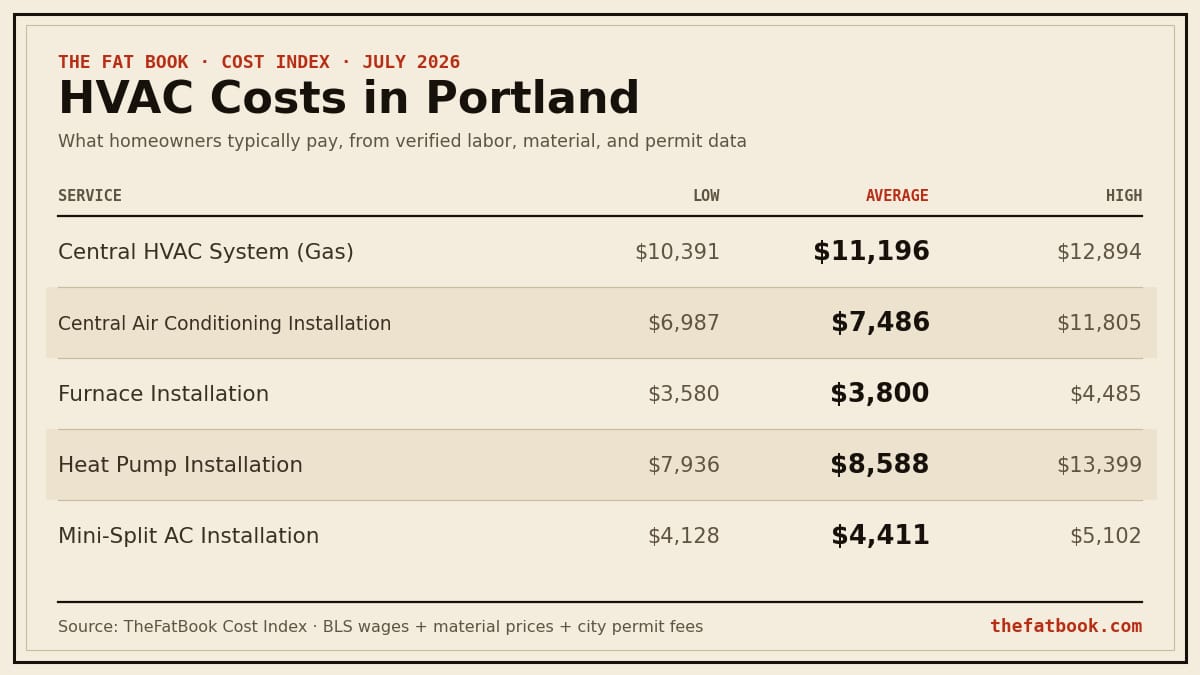
Embed this chart on your site (free, with attribution)
| Service | Low | Average | High |
|---|---|---|---|
| Central Air Conditioning Installation · 2 ton | $7,206 | $7,707 | $11,877 |
| Add AC to Existing Furnace | $8,837 | $9,512 | $10,239 |
| Furnace Installation | $3,703 | $3,924 | $4,511 |
| Mini-Split AC Installation · 1 ton | $4,260 | $4,544 | $5,133 |
| Heat Pump Installation · 2 ton | $8,156 | $8,810 | $13,480 |
| Central HVAC System (Gas) | $11,629 | $12,455 | $13,343 |
| Mini-Split Heat Pump Installation · 1 ton | $4,260 | $4,544 | $5,133 |
| Remove Heating System | $313 | $359 | $408 |
| Baseboard Heater Installation | $983 | $1,091 | $1,208 |
| Gas Wall Furnace Installation | $2,660 | $2,848 | $3,049 |
| Hydronic Heating Installation | $12,028 | $12,717 | $14,987 |
| Ductwork Installation | $10,587 | $12,095 | $13,718 |
| Attic Insulation Installation · 1,000 sqft | $2,467 | $2,825 | $3,209 |
| Fiberglass Batt Insulation · 1,000 sqft | $2,794 | $3,198 | $3,634 |
| Blown-In Insulation · 1,000 sqft | $2,139 | $2,448 | $2,781 |
| Rigid Foam Insulation · 200 sqft | $819 | $938 | $1,065 |
| Whole-House ERV/HRV Installation | $3,047 | $3,267 | $3,602 |
| AC Repair | $280 | $320 | $364 |
| Furnace Repair | $280 | $320 | $364 |
| Multi-Zone Mini-Split Installation | $6,086 | $6,454 | $7,494 |
| Spray Foam Insulation · 1,000 sqft | $3,045 | $3,486 | $3,960 |
| Boiler Installation | $4,979 | $5,340 | $5,972 |
| Whole-House Dehumidifier Installation | $2,614 | $2,754 | $3,133 |
| Wood Stove Installation | $3,926 | $4,162 | $4,793 |
| Pellet Stove Installation | $3,657 | $3,872 | $4,374 |
| Gas Fireplace Installation | $3,463 | $3,668 | $4,216 |
| Chimney Liner Installation | $3,155 | $3,357 | $3,670 |
Before you get bids in Portland.
Portland permits.
$12k building fee: $710
$25k building fee: $1,079
Electrical base: $195
Plumbing base: $71
HVAC base: $187
Source-backed permit facts from PermitCalculator.com and the underlying permits_compiled dataset. Always confirm final requirements with the local building department before filing.