Is your outdoor living & hardscapes bid fair?
Concrete Patio Cost in 2026: You Are Buying the Mix, Not the Slab
Chuck Thompson is a retired homebuilder and contractor who owned L.C. Thompson Construction in Jefferson City, Missouri. TheFatBook Cost Index V3 2026 (built from BLS wage and Craftsman labor data) referenced throughout this article is our proprietary dataset that powers all of our calculators and bid-fairness checkers. Full details are on the methodology tab.
A 400-square-foot concrete patio averages $4,063 installed in 2026, with most jobs between $3,649 and $4,508, per our index. That works out to $10.16 per square foot, and the range runs $9.12 to $11.27. The number looks simple. The decision behind it is not.
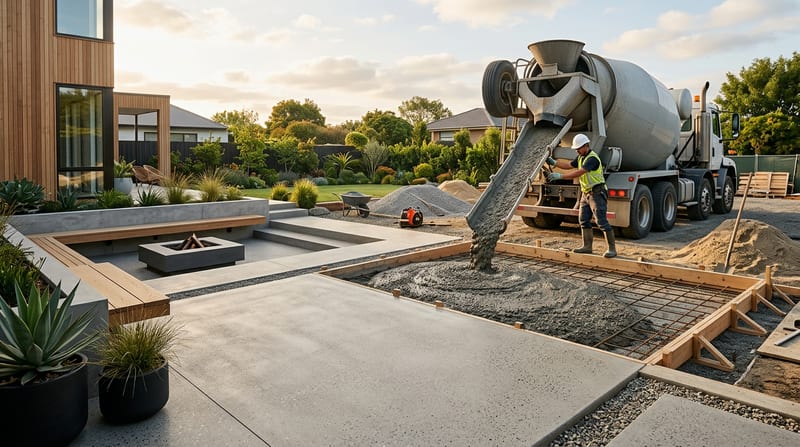
A concrete patio is a materials job before it is anything else. Materials are the biggest line on the bill at $1,590, which is 38% of the total, and what you are actually buying in those materials is the mix. Air entrainment and slump, two things no homeowner ever asks about, decide whether the slab cracks. The per-square-foot price reads clean at $10.16. The cheap bid saves money in the one place you cannot see, the concrete itself, and you pay it back in cracks.
Where $4,063 Goes
| Component | Cost | Share |
|---|---|---|
| Materials | $1,590 | 39.1% |
| Labor (22 crew-hours) | $917 | 22.6% |
| Permit | $0 | 0% |
| Overhead | $823 | 20.2% |
| Contractor margin | $733 | 18% |
| Total | $4,063 | 100% |
Materials lead, and they lead by a lot. The finisher who runs the pour earns a base wage of about $29.81 an hour, carried at $41.70 loaded once you add roughly 40% for workers' comp and payroll taxes. The crew books about 22 hours on a job this size. We carry no permit allowance in the national basis, because the real fee swings hard from city to city, so pull your local number before you budget it. The margin is earned, not padding. One thing the materials line hides: it is concrete, rebar or mesh, gravel base, and forms, not just the wet concrete that shows up in the truck.
What the Mix Actually Buys
Check your bid Compare your contractor estimate against TheFatBook city pricing, markup, and lowest realistic price data. Run the Bid Checker →
This is where a patio is won or lost, and the spec sheet on the concrete is a real document, not a formality. The National Ready Mixed Concrete Association (NRMCA) says exterior flatwork such as driveways, sidewalks, patios, and pool decks in freeze-thaw or deicer conditions typically uses air contents of 4% to 7%, depending on aggregate size. Those tiny entrained air bubbles are what let the slab survive freezing without spalling. NRMCA also recommends a moderate slump not exceeding 5 inches for general slab work, and it warns that excessive on-site water and high-slump concrete increase cracking risk. Translation: a crew that adds water to make the pour easier is making the slab weaker. A cold-climate patio poured without proper air entrainment will flake at the surface, and no sealer fixes that after the fact. This is the part of the bill the cheap quote shaves, because it is the part you cannot see in the finished slab.
A Buyer Can Check the Concrete
NRMCA says ready-mixed concrete is sold by volume yield under ASTM C94, so a buyer can compare the cubic yards ordered against the ticketed volume on the delivery slip rather than guessing from the size of the truck. The practical reading is short. Ask the contractor what air content and slump they are speccing for your climate, and keep the delivery ticket. A contractor who can answer that question is buying the right concrete for your job. One who shrugs is buying whatever is cheapest at the plant that day, and you inherit the difference.
What Changes City to City
| Metro | Average | Range | Crew labor |
|---|---|---|---|
| Atlanta | $3,693 | $3,305 to $4,110 | $740 |
| Austin | $3,747 | $3,321 to $4,206 | $751 |
| Phoenix | $3,914 | $3,490 to $4,369 | $861 |
| Denver | $4,222 | $3,770 to $4,709 | $897 |
| Chicago | $4,954 | $4,493 to $5,501 | $1,554 |
Atlanta to Chicago is a $1,020 gap, about 29% on the same patio. The crew explains about three-quarters of it, $758 in labor. The rest is the company's operating cost, what it takes to run a contracting business in a high-cost market. Chicago and Denver are also the freeze-thaw markets on this list, the two places where the air-entrainment spec earns its keep. So the cold-climate patio costs more to build and needs the better mix at the same time. You pay for the weather twice.
How to Read a Concrete Patio Bid
Divide the bid by the square footage yourself before you do anything else. Our index puts a fair installed patio around $10.16 a foot, with a real range above and below it. A number well under that is not a deal. It is a thinner slab, a leaner mix, or skipped base prep, and all three show up later as cracks or settling rather than as savings. Ask three questions and listen to the answers: how thick is the slab, how is the base prepared, and what is the concrete spec. The contractor who answers all three plainly is the one selling you a patio that lasts. You can pressure-test a number against the data with the outdoor living bid checker before you sign.
Frequently Asked Questions
How much does a concrete patio cost?
Right around $10.16 per square foot installed for a standard poured slab. Thickness, base prep, and the concrete mix move that number more than the finish does, so a quote far below it is usually cutting one of the three to get there.
Why do some concrete patios crack and others do not?
It comes down to control joints, base prep, and the mix. NRMCA warns that excessive water and high-slump concrete raise cracking risk, and in cold climates the right air content keeps the surface from spalling. A patio that cracks early usually cut one of those corners to hit a lower price.
Is stamped or colored concrete worth it?
Decorative finishes such as stamping, integral color, and exposed aggregate add materials and finishing labor on top of the base slab, so they raise the per-foot price. That part is real. The structural decision, thickness and mix, matters more for how long the patio lasts than the finish does. Spend on the slab first and the look second.
Figures are the national project basis from TheFatBook Cost Index V3 2026 for a 400-square-foot poured concrete patio; metro rows reflect local wages and operating costs. Sources: Craftsman National Estimator BOM, BLS OES wages, NRMCA, verified permit fees.