Is your outdoor living & hardscapes bid fair?
Stamped Concrete Patio Cost in 2026: A Slab Done Right, Plus a Craft on Top
Chuck Thompson is a retired homebuilder and contractor who owned L.C. Thompson Construction in Jefferson City, Missouri. TheFatBook Cost Index V3 2026 (built from BLS wage and Craftsman labor data) referenced throughout this article is our proprietary dataset that powers all of our calculators and bid-fairness checkers. Full details are on the methodology tab.
A 400-square-foot stamped concrete patio averages $7,348 installed in 2026, with most jobs landing between $6,599 and $8,155, per our index. That comes to $18.37 per square foot, and the range runs $16.50 to $20.39. The patio you are paying for is really two jobs stacked on each other.
Underneath is an ordinary slab. It lives or dies on the same things any slab does, the base it sits on and the concrete you pour into it. On top of that slab is a craft. Color goes in, a release agent goes down, patterned mats get pressed into the surface, and the whole thing gets sealed. All of that decorative work happens by hand in the few minutes before the concrete sets up. That hand work is the reason a stamped patio costs more than a broom finish. Spend on the slab first. The pattern comes second.
Where $7,348 Goes
| Component | Cost | Share |
|---|---|---|
| Materials | $2,222 | 30.2% |
| Labor (61.6 crew-hours) | $2,314 | 31.5% |
| Permit | $0 | 0% |
| Overhead | $1,487 | 20.3% |
| Contractor margin | $1,325 | 18% |
| Total | $7,348 | 100% |
Materials and labor run close here, and that is the tell. The finisher who runs the pour and the stamping earns a base wage of about $26.95 an hour, carried at $37.57 loaded once you add roughly 39% for workers' comp and payroll taxes. The crew books about 61.6 hours on a job this size. That is more than a plain slab takes, because the coloring and stamping cannot be rushed and cannot be redone once the concrete firms up. We carry no permit allowance in the national basis, because the real fee varies by city, so pull your local number before you budget it. The margin is earned, not padding. One thing the materials line carries that a plain slab does not: on top of the concrete, base, reinforcement, and forms, you are also paying for the color hardener, the release agent, and the sealer.
What the Stamping Actually Buys
Check your bid Compare your contractor estimate against TheFatBook city pricing, markup, and lowest realistic price data. Run the Bid Checker →
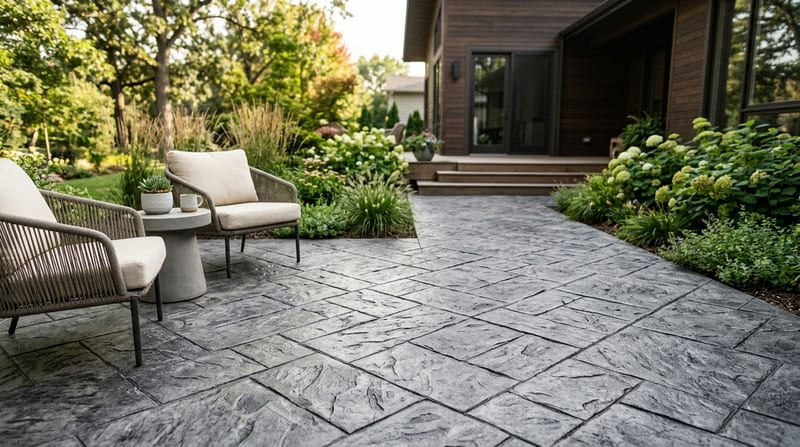
The decorative layer is the part most homeowners are buying the patio for, so it helps to know what it is. A crew pours the base slab, adds color either as integral pigment mixed into the concrete or as a dry-shake hardener worked into the wet surface, dusts on a release agent, and presses patterned mats into the concrete while it is still plastic. Then they cure it and seal it. The pattern is permanent the moment the slab sets. There is no second pass.
Here is the catch. None of that craft matters if the slab cracks, and a stamped slab cracks for the same reasons a plain one does. The National Ready Mixed Concrete Association says exterior flatwork such as patios in freeze-thaw or deicer conditions typically uses 4% to 7% air content depending on aggregate size. Those tiny entrained air bubbles are what let the slab survive freezing without spalling. NRMCA also recommends a moderate slump not exceeding 5 inches for general slab work, and it warns that excess on-site water and high-slump concrete raise the risk of cracking. So a crew that hoses extra water into the mix to make the pour go easier is weakening the slab you cannot see in order to speed up the part you can. A cracked stamped patio is worse than a cracked broom finish, because the pattern draws the eye straight to the flaw.
Chuck's Take: I tell people a stamped patio is two bills wearing one number. There is the slab, which is base prep and good concrete and control joints, and there is the show, which is the color and the mats and the seal. The fellow doing the stamping has maybe twenty minutes to get the whole pattern down before the concrete quits cooperating, so that is real skill and you pay for it. But I have seen pretty patios crack in two winters because somebody watered down the mix to buy himself more working time. Pay for the slab first. A perfect pattern on a bad pour is just a nicer-looking crack. Leonard "Chuck" Thompson, LC Thompson Construction Co.
The Questions That Tell You Who You Hired
NRMCA says ready-mixed concrete is sold by volume yield under ASTM C94, so you can compare the cubic yards ordered against the ticketed volume on the delivery slip rather than guessing from how big the truck looks. Keep that ticket. Beyond that, ask the contractor what air content and slump they are speccing for your climate. A crew that can answer is buying the right concrete for your job. A crew that shrugs is buying whatever the plant has cheapest that morning, and you inherit the difference the first time the temperature drops.
Then ask about the finish. How many colors. Whether there is a hand-applied border. What sealer they use and how often it needs to come back. The decorative sealer is maintenance, not a one-time step. It gets reapplied every few years to hold the color and protect the surface, where a plain broom finish needs none. Control joints still get cut to manage cracking, and on a stamped slab a good crew works them into the pattern so they read as part of the design instead of a scar across it.
What Changes City to City
| Metro | Average | Range | Crew labor |
|---|---|---|---|
| Atlanta | $6,601 | $5,909 to $7,347 | $1,919 |
| Austin | $6,717 | $5,954 to $7,540 | $1,957 |
| Phoenix | $7,158 | $6,384 to $7,991 | $2,264 |
| Denver | $7,662 | $6,841 to $8,546 | $2,324 |
| Chicago | $9,257 | $8,395 to $10,215 | $3,716 |
| Atlanta to Chicago is about a $1,552 gap, roughly 32% on the same patio. The crew explains most of it, about $1,146 in labor. The rest is the company's operating cost, what it takes to keep a contracting business running in an expensive market. There is a second thing buried in this table. Chicago and Denver are the freeze-thaw markets on the list, the two places where the air-entrainment spec earns its keep. So the cold-climate patio costs more to build and needs the better mix at the same time. The weather charges you on both ends. |
How to Read a Stamped Patio Bid
Do the division yourself before anything else. Our index puts a fair installed stamped patio around $18.37 a foot, with real room above and below that. A bid well under the bottom of the range is not generosity. It is a thinner slab, a leaner mix, skipped base prep, or a thinner decorative budget, and every one of those surfaces later as a crack, a settle, or color that washes out. It also helps to know what you would pay without the craft on top. Compare any stamped number against a plain broom-finished slab and the difference you see is roughly what the color, mats, and sealer are worth. The patio that lasts is sold by the contractor who can talk about the slab as fluently as the pattern. When you have a bid in hand, you can run it against the outdoor living bid checker before you sign anything.
A note on bigger jobs. The $7,348 figure is a 400-square-foot patio on accessible, prepared ground. It scales by the foot, so size moves it in a straight line. It climbs faster than that for pattern complexity, more than one color, a hand-applied border, hard truck access, or poor soil that needs extra base or a thicker slab. Tying into an existing structure or stepping down a grade adds forming labor on top.
Frequently Asked Questions
How much does a stamped concrete patio cost?
Right around $18.37 per square foot installed for a new poured slab. The base prep and the concrete mix decide whether it lasts, and the pattern and color decide what it costs above a plain finish, so a quote far below the range is usually trimming the structure to get there.
Why does stamped concrete cost more than a plain slab?
The structure is the same, but the craft is the premium. A stamped patio adds color hardener or integral pigment, a release agent, the patterned mats, and a decorative sealer, and pressing that pattern is hand labor in a tight window before the concrete sets. You are paying for materials and skill that a broom finish simply does not use.
Does stamped concrete crack, and does it need upkeep?
It cracks for the same reasons any slab does, the base under it, the mix poured into it, and whether control joints were cut to manage movement. The upkeep is the sealer. On a stamped patio it has to be reapplied every few years to hold the color and protect the surface, where a broom finish asks for nothing.
Figures are the national project basis from TheFatBook Cost Index V3 2026 for a 400-square-foot stamped concrete patio. Metro rows reflect local wages and operating costs. Sources: Craftsman National Estimator BOM, BLS OES wages, NRMCA, verified permit fees.