Is your painting bid fair?
How Much Does Deck Staining Cost in 2026?
Chuck Thompson is a retired homebuilder and contractor who owned L.C. Thompson Construction in Jefferson City, Missouri. The cost figures throughout come from our 2026 dataset. Full details are on the methodology tab.
Staining a 400 sq ft coated surface runs $713 nationally, with most jobs landing between $652 and $868. We picked that project size because it gives you a real per-square-foot price instead of one warped by minimum charges.
The National Number for a 400 SF Deck
Four hundred square feet sits in a sweet spot. It mirrors real jobs without letting fixed costs run the math. At that size you're paying about $1.29 per square foot, a fair mix of labor for washing and coating plus the materials themselves. Bigger decks start earning back some savings once the crew clears setup and finds its rhythm. Don't expect every quote to hit $713 on the nose. What pushes the number around inside that $652 to $868 band is your regional labor rate, the shape your boards are in, and the stain you pick. Knowing the national figure first kills the sticker shock when local bids come in, because you can eyeball whether a proposal fits the scope it describes.
Why Small Decks Hit the Minimum Charge
Plenty of crews bill a $250-$500 minimum on small staining work. A 150 SF landing ends up costing nearly what a 300 SF deck does, since mobilization, the wash down, and a half-day visit don't shrink with the footage. On little jobs you're really paying for the time it takes to show up and get set, not the square footage. The per-foot price drops as the deck grows because that setup cost spreads across more wood. Measure your actual coated surfaces, every one of them, so the bids you get match what's really there.
What You're Paying For: Stain Types and Surface Prep
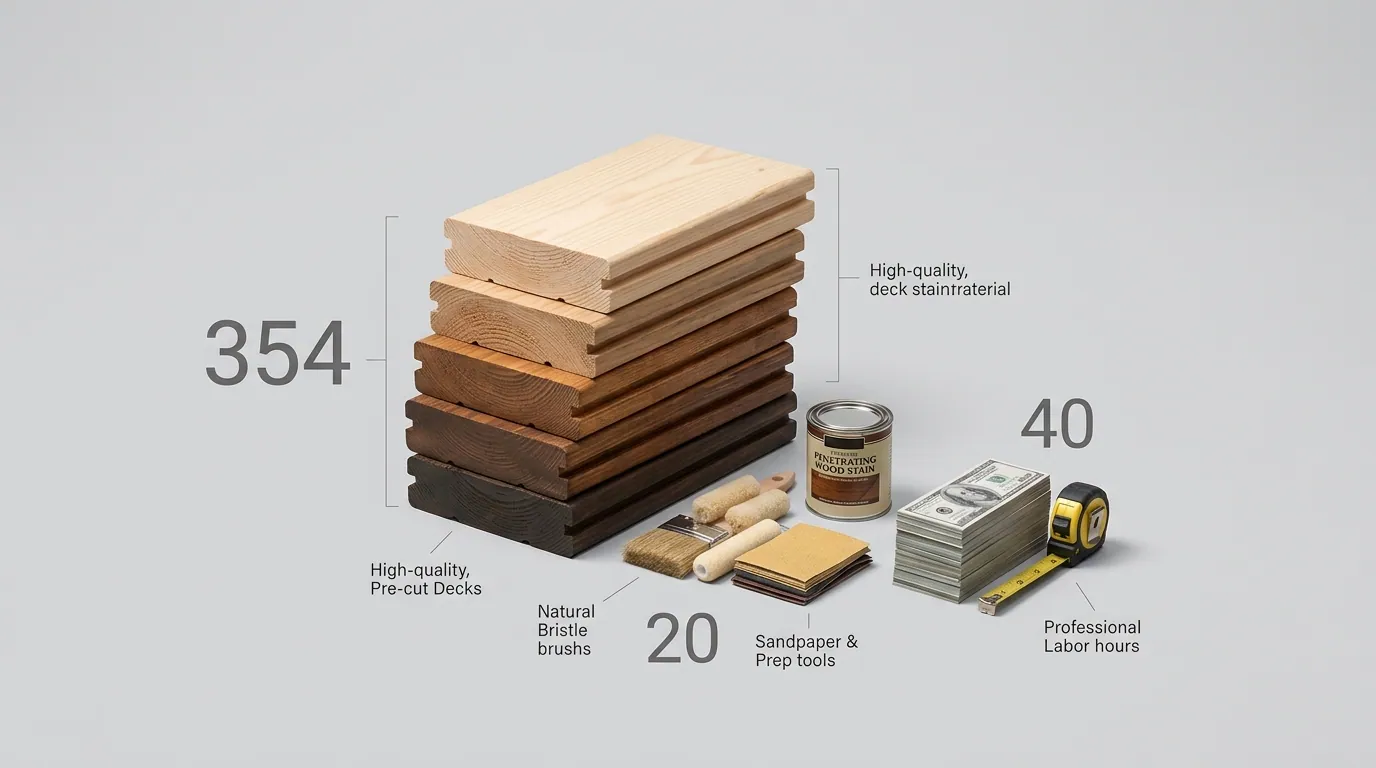
Penetrating stains beat solid-color finishes on decks. Yes, you recoat more often. That's a fair trade for skipping the big repairs down the line.
Penetrating Clears vs Semitransparent Stains
Penetrating clears sink into the wood and protect it from inside. Semitransparent stains add a little color without fully sealing the surface. The USDA Forest Products Laboratory notes that decks are usually finished with penetrating clears, lightly pigmented clears, or semitransparent stains, which need more frequent reapplication than paint but seldom fail by cracking and peeling. That's why they stay the default. You trade a shorter recoat cycle for never having to scrape and strip. And the money cuts both ways: a penetrating clear means recoating every two to three years at materials cost, while a film finish that peels forces a full strip and sand job closer to that $795 stripping line before you can even start over.
Why Solid-Color Finishes Peel on Decks
Solid-color finishes peel because they build a thick film that traps moisture and cracks under foot traffic on horizontal surfaces, where water sits instead of running off. I put a solid-color finish on a client's south-facing deck back in Jefferson City once, against my own advice, because the homeowner had her heart set on the color. Two summers later it was lifting in sheets, and the strip-and-redo ran her more than the original job. The USDA Forest Products Laboratory warns that solid-color stains should not be used on decks unless specially formulated, because they lack abrasion resistance and tend to fail by peeling. Seasonal wood movement piles on stress the coating can't take, so cracks open up and the finish lifts in patches. The FPL Wood Handbook (FPL-GTR-190, Chapter 16, 2010) lays out exactly how this happens. Most guides skip it. Solid color is a false economy on a deck, and it shoves you into scraping, sanding, and starting over way sooner than you should.
Prep: Wash, Sand, and Absorb
Wash and sand the deck first. That opens the wood so the stain can soak in the way it's supposed to. FPL advises limiting semitransparent deck stain to what the surface can absorb. Brush it on; roller and spray tend to lay down too much product on horizontal surfaces. Too much on top and you get the very peeling the right stain was meant to dodge. Skimp on prep and you'll be back scraping peeled stain in two seasons.
Stain Tiers: What a Gallon Costs by Grade
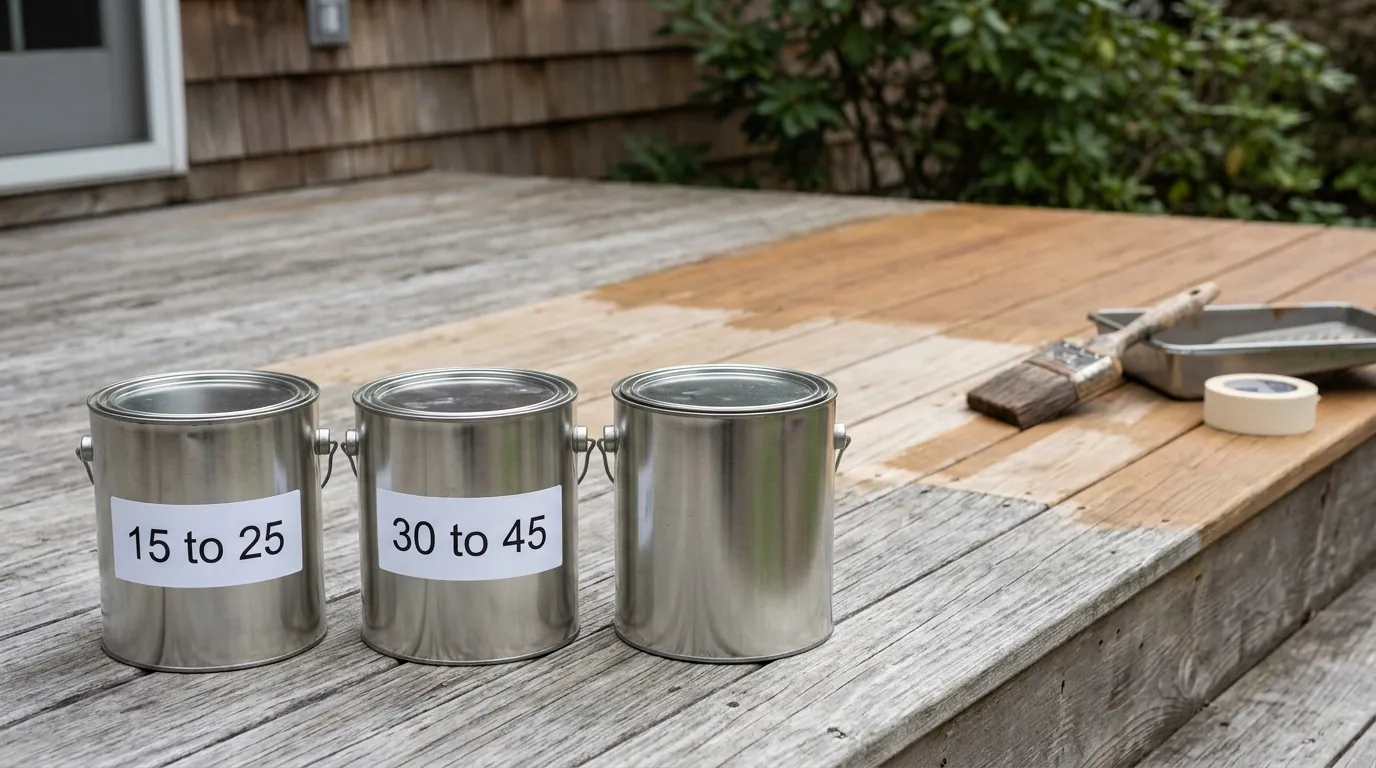
The gallon price on the shelf makes the choice look pricier than it really is. That can is a small slice of the whole project.
What the Stain Itself Costs on This Job
The material line runs 25 percent of the job total on a 400 sq ft deck, and that covers stain plus sundries, not just the cans on the shelf. Coverage is the real variable. Weathered or rough-sawn boards drink far more product than smooth, recently sanded decking, so the same square footage can need half again as much stain after a few neglected seasons.
The Forest Products Laboratory is blunt about over-application: "Limit the application of semitransparent stain to what the surface can absorb. The best application method is by brush; roller and spray application may put too much stain on horizontal surfaces." Coats past the absorption point are wasted product, not added protection. A careful crew quotes by surface condition, not a flat gallons-times-price formula.
Stepping up a stain grade adds maybe $30 to $61 of product on a deck this size. If the materials line on a bid jumps by hundreds instead, it is carrying labor or margin under a different name, and the contractor should be able to say which.
Coats and Coverage on a Deck
Working out coats and coverage for your deck means reading the product specs closely, because a 400 SF deck can drink up wildly different amounts depending on the grade you pick and the state of the wood. Value options in the $15 to $25 range often soak in deeper, so you need more volume to build the same protective layer that core and premium grades give you with less. That bumps your effective cost per square foot even when the label price looks like a steal. The premium for trading up still stays small overall. I'd plan around the number of coats the maker recommends so you're not running back to the supply house mid-project.
Where the Labor Hours Go
Less of that $713 pays the crew on site than the 50 to 70 percent figures you'll read elsewhere suggest.
The labor line is $263. That's 31 percent of the total, about half a day of labor to wash, sand, and coat the 400 square foot surface, spread over two visits because the deck has to dry after the wash.
The Half-Day Install Line
That half day of labor covers pressure washing, sanding the rough patches, then rolling or spraying the recommended coats carefully enough to avoid thin spots and future peeling. The wash and the coats land on separate visits because the wood has to dry in between. A seasoned crew moves fast once setup's done, so the whole scope rarely runs longer even though every step demands precision and a close read of the manufacturer's guidelines. OEWS reports painters earn a national median wage of $23.75 per hour, or $49,400 a year (BLS). That's the raw paycheck number, and it undersells what it costs to put a crew in your backyard. Start from a $26.64 regional base rate, load it with taxes, insurance, and benefits, and you're at $36.54 per hour for this install line. The result lands at $263 because the hours are modest and the work's efficient for this scope.
Scope sets the number, not skimping.
Loaded Wages vs Aggregator Labor Shares
Those aggregator reports claiming labor runs 50 to 70 percent are folding overhead, vehicles, office costs, and contractor margin into one big labor bucket. Our $263 line counts only the direct install hours, so it reads as a minority of the $713 while their number balloons. We split the pieces apart so you see exactly what pays the painters versus what keeps the lights on at the business. Fence staining carries an $82 labor line against its $1,069 total because vertical surfaces and access change the time it takes.
Deck Staining Prices by Metro
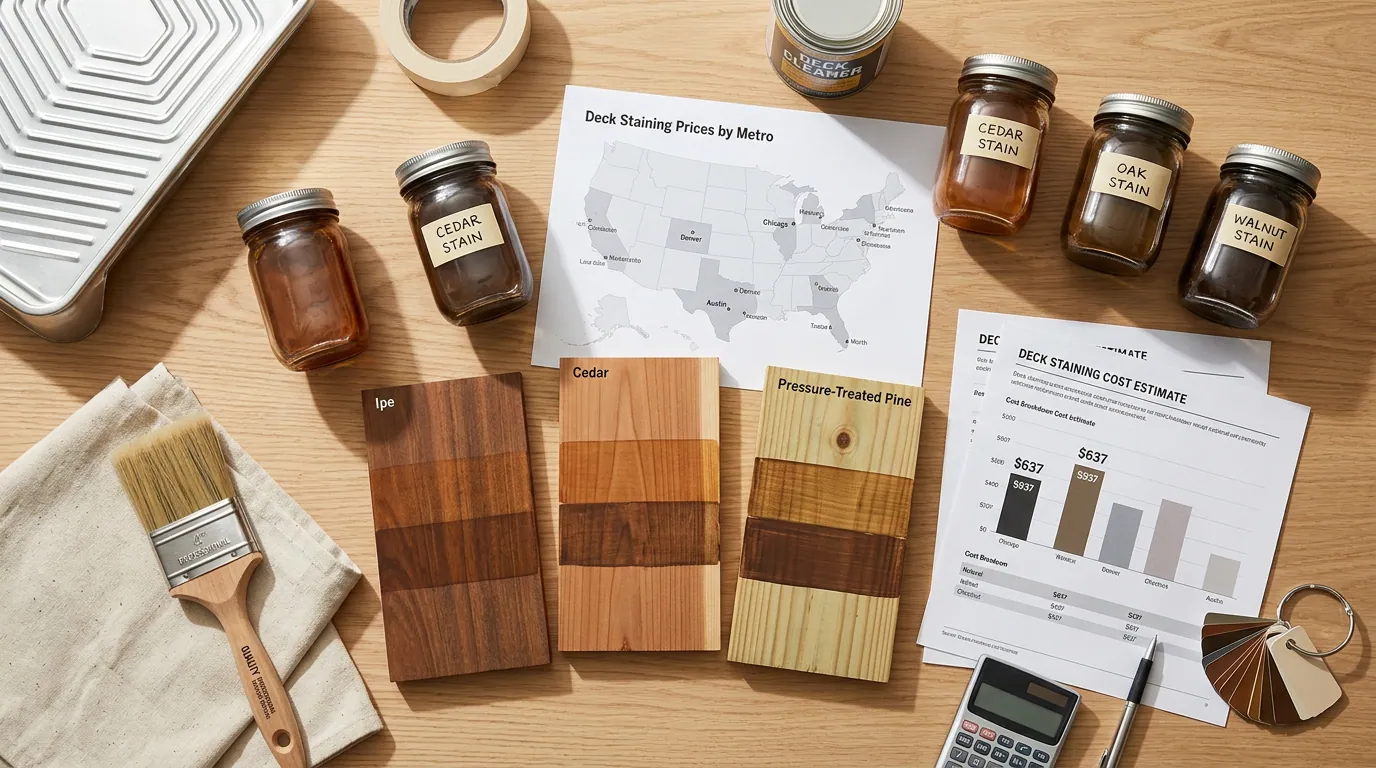
Chicago hits $635 for a typical deck staining job. That jumps out against the $713 national average and the much lower Austin price of $472, per our cost analysis.
The Five-Metro Spread
Five metros, one clear pattern, and it matters once you're collecting local bids. Austin sits at the bottom. Chicago runs highest by a wide margin.
| Metro | Average Cost | Difference from $713 National |
|---|---|---|
| Austin | $640 | -$73 |
| Atlanta | $654 | -$59 |
| Phoenix | $691 | -$22 |
| Denver | $764 | +$51 |
| Chicago | $897 | +$184 |
Our figures.
Chicago's $635 sits $121 over baseline while Austin saves you $42, and the whole spread runs $163 between the two ends. Part of why Chicago runs high is a short staining season. NOAA Climate Normals put it at 236 paintable days a year against 364 in Phoenix, so northern crews cram the same demand into far fewer working days, and both labor rates and scheduling pressure climb. Austin never faces that squeeze. Local labor rates, material handling, and overhead carve out these gaps. A bid in one city rarely maps onto another. Denver at $550 or Phoenix at $501 will track closer to average, but you still need to check against the real numbers for that market. Pull local data early.
Component Breakdown: Materials, Overhead, Margin
Materials total $190 at 25 percent, overhead adds $151 at 29 percent, and the install-labor line carries over from the section above. Contractor margin sits at $78 (15 percent), so the pieces add up plainly to the $713 total with cost to deliver at $604 (85 percent). I push every homeowner to demand that contractor margin be called out on its own, because most bids bury it and you'll never know whether the quoted profit runs at our level or way above it. Our figure sits below the 20-40 percent range many painting contractors target.
That structure keeps the per square foot price under typical exterior painting rates of $1.50-$4: the stain soaks into the wood as one coat instead of building up multiple film layers like paint, which eats more product and time. Regional factors can still push your quote higher if the boards need extra prep or the access is rough, so dig into those details before you sign anything. Watch that line hard in the higher-cost cities, where it compounds.
Rules of Thumb for Planning Your Project
Your best defense against cost overruns on deck staining is doing it before the old coating fully gives out. Stay ahead of that line and the project stays in standard pricing instead of sliding into a full restoration that almost no budget plans for.
Coats, Temperature, and the Weather Window
Sherwin-Williams Duration calls for one coat on repaints, two coats for unpainted surfaces, and allows low-temperature application down to 35°F. A fresh deck therefore needs the heavier scope and a longer weather window. Paintable days per NOAA Climate Normals 1991-2020 run from 236 in Chicago to 364 in Phoenix, so northern decks live with a tighter staining season. Book early in that window so the crew can lay the coats under the right conditions without rushing or shorting the finish.
When to Budget for Stripping First
When the old finish is failing, set aside money for paint stripping as its own priced line at $795 nationally, since it's a separate service that comes before re-staining and isn't baked into the $713. Staining on schedule beats waiting until the boards gray out and need stripping first. Build that possible add-on into your planning so the total doesn't blindside you when the surface inspection turns up lifting or cracking.
Frequently Asked Questions
How do small decks usually get priced?
Most small jobs hit a minimum visit charge, so ask what that minimum is and compare it against your actual square footage.
What's the contractor margin on a deck staining job?
On the typical $713 installed average, the contractor margin is $78, the portion left after labor, materials, and overhead are paid. Ask for it as its own line. If one bid shows it and another folds it into "labor" or "materials," you're comparing sticker prices instead of comparable scopes.
When should I expect a stain cost to climb beyond the normal range?
If the old finish is failing and needs stripping first, add about $795 as its own line before staining even starts. Heavy prep or rough access pushes the bid the same way, and tight-season metros like Chicago pile labor and scheduling pressure on top.
Why does labor matter less than materials in most deck staining bids?
The install-labor line on a deck is a smaller slice than the coating and related materials. In our baseline labor is $263, and that covers the on-site work only: washing, prep time, and applying the coats.